
Pages

Showing posts with label Iran. Show all posts

Monday, March 19, 2012

No "Arab Spring” without women in civic life

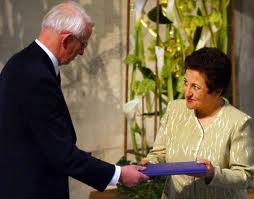
Shinin Ebadi receiving her 2003 Nobel Peace Prize
I often wondered if the turmoil sweeping our region for the past 14 months can rightly be dubbed an “Arab Spring.” In places, it is more of an “Arab nightmare” begun in winter and still trying to shake off the snow. But when a Nobel Peace Prize laureate and one of Iran’s leading lawyers and human rights activists doesn’t agree with the term, it is worth reading.
In an article for the Wall Street Journal dated March 14 and titled “A Warning for Women of the Arab Spring,” Shirin Ebadi hopes those who have risen against dictatorships will “reflect and learn from what happened to us in Iran.”
Adapted from her chapter in the new Human Rights Watch book, "The Unfinished Revolution: Voices From the Global Fight for Women's Rights" (edited by Minky Worden, Seven Stories Press, 2012), Ms Ebadi writes: I do not agree with the phrase ‘Arab Spring.’ The overthrow of dictatorships is not sufficient in itself. Only when repressive governments are replaced by democracies can we consider the popular uprisings in the Middle East to be a meaningful ‘spring.’”
Ms Ebadi adds, “Since women make up half of the region's population, any democratic developments must improve the social and legal status of women in the Arab world. It appears the Tunisian society has strong civil institutions, and there is much hope that democracy can take hold there. But in Egypt, many political actors are talking about returning to Islamic law, which could result in a regression of rights for women and girls similar to what we experienced in Iran in 1979…
“Shariah law and women's rights do not have to be mutually exclusive. Although the 1979 revolution in Iran is often called an Islamic revolution, it can actually be said to be a revolution of men against women… When I first read the Islamic Penal Code instituted after the revolution, I couldn't believe my eyes. The drafters of this document had effectively taken us back 1,400 years.”
The 2003 Nobel Peace Prize laureate notes, “The law that is being enforced in Iran today does not consider women to be full human beings. Instead, it ascribes to women a value half that of a man…”
And one thing I totally agree with – and highlighted in my post on International Women’s Day (see below) -- Ms Ebadi writes: “Education is one key to the future of women around the world. They must become aware of their rights. “
Ms Ebadi concludes the Wall Street Journal extract by saying, “The true ‘Arab Spring’ will dawn only when democracy takes root in countries that have ousted their dictatorships, and when women in those countries are allowed to take part in civic life.”
I cannot agree more and strongly recommend reading Ms Ebadi's article in full here.
Related posts:

Sunday, March 20, 2011

Saudi ponders Syria upheaval spark

Guest post by Middle East publisher F. Najia

With the West now pounding Libya, I am finding it increasingly difficult to keep up with news, analyses and reactions on the unrest spreading throughout the Arab world. But one leader comment caught my attention this morning. It is by Tariq Alhomayed, editor in chief of the Saudi newspaper of records Asharq al-Awsat, and focuses on the prospects of an upheaval in Syria.

Following is my full translation of Alhomayed’s opinion piece

Tariq Alhomayed
Demonstrations erupted after Friday prayers in several Syrian cities namely, Damascus, Homs, Banias and the southern Syrian city of Deraa on the border with Jordan. People were killed, wounded or arrested as a result. Will that spark (turmoil) in Syria?

Syria is definitely not immune to the demonstrations and uprisings sweeping our region. I said time and again: Syria and the other Arab states are by no means cut from the same cloth. Tunisia is not Egypt. Bahrain, where confessional motivations dominate, is unlike the rest. Yemen is also different… Sanaa is extremely complex, if not a time bomb, given the Yemeni president’s obduracy. That leaves Libya, where the landscape remains open to all manners of coercion.

Syria then is not immune to events in our region. Matter of fact, Damascus invariably chooses to escape forward, using all excuses and tricks to postpone the hour of confronting the truth – the home front truth relating to its people. The latter takes precedence over reality on the external front -- which is perhaps less daunting – namely, calm on the borders with Israel. The calm there is greater than the calm that prevailed on the Egyptian-Israeli border throughout the Mubarak years.

Syria’s problems are a replica of problems facing all countries that escape forward and imagine the wheels of time do not spin and tricks succeed forever. But modern history reminds us that slogans do not satiate the appetite of hungry mouths, that some facts need addressing, that there is a moment when issues fall due.

Pretence and the lecturing of people as (Syrian president aide) Buthaina Shaaban does in her articles that read like having been filed from Switzerland cannot hide the facts. The best way to handle facts is to face them.

True, Syria is unlike the other troubled countries, but the reasons for complaint and discontent there are more pronounced. Syria is the most glaring example of asymmetry in the minority/majority game that nowadays fascinates the international community, the mass media and the newswires. These have not thrown their weight behind the protests in Syria as they did in the case of Bahrain, for instance. The reasons could be censorship or the lack of a confessional denominator as in Bahrain’s case. That’s especially true of news photographers and biased information outlets.

Accordingly, if this is the spark (for rebellion) in Syria, then a very hard time awaits Syria, particularly after the UN Security Council resolution against Libya and the prevailing international mood to play the minority/majority game and the lack of international faith in the Syrian modus operandi. The latter is a byproduct of the tortuous course of erroneous Syrian policies, of Damascus’s historic hostility towards the Moslem Brotherhood, over and above the tense internal political and economic situation.

As I said, the dilemma of the Arab republics is great and what is yet to come is onerous. Experience shows the continued defiance by citizens of their repressive regimes, as happened in Tunis, coupled with a state of internal resentment, usually leads to an explosion.

Hence, it is important to closely monitor events in Syria and gauge the anxieties and agitations of Iran and Hezbollah and the lengths they would go in their extremism and loss of credibility. Would they condemn, for example, the use of force against Syrian civilians and back their right to demonstrate peacefully as they did in the case of Bahrain? I think the reader knows the answer.
Enhanced by Zemanta

Tuesday, March 1, 2011

Winds of change or drums of war?


Front page photo from Libya in today's Asharq Alawsat

Guest post by veteran Middle East publisher F. Najia

Arab press heavyweights are in a “morning-after” mode and beginning to wonder if the ongoing sea change in the Arab world will end well.

“Where is this inferno leading?” asks editor in chief Tariq Alhomayed in the leading Saudi daily Asharq Alawsat. “Secretary of State Hillary Clinton having said backing political change in the Arab world is a ‘strategic necessity,’ the United States and some European nations are now hinting at the use of force against the Gaddafi regime,” he notes, adding:

“That’s understandable, or let me say acceptable even.  But the question remains: what about change in Iran? What can Washington, or the West, do against the Iranian regime that is terrorizing Iranian opposition leaders (Mehdi) Karoubi and (Mir-Hossein) Mousavi with imprisonment or placement under house arrest?

“Will America support the Iranian opposition too, or intervene militarily (in Iran)? Or is that for Arabs only? If so, what will Washington do if, God forbid, conditions in Yemen worsened -- with the Yemeni president (Ali Abdullah Saleh) deciding to hold out, and the opposition insisting on his departure? Will Washington resort to military force (in Yemen), all the more so since some Washington pundits fear a takeover there by al-Qaeda? How can America describe change in the region as a strategic necessity when it dreads it in Yemen, for instance, or remains tightlipped on 13 deaths in (anti-government) protests in Iraq?”

Amine Kamourieh, writing in Beirut’s leading daily an-Nahar, fears the tsunami of change sweeping Libya, Algeria, Tunisia, Egypt, Bahrain and Oman “could lead one of the aggrieved sides or schemers to trigger a major regional war that will dampen the clamor for change altogether.”