Pages

Showing posts with label Blog Action Day. Show all posts

Wednesday, October 16, 2013

Human Rights: 65 years on


Article I of The Universal Declaration of Human Rights proclaims: “All human beings are born free and equal in dignity and rights. They are endowed with reason and conscience and should act towards one another in a spirit of brotherhood.”

It is 65 years since the declaration was adopted by the UN General Assembly as the first global expression of rights to which all human beings are essentially entitled. It is thus sad to see freedom, equality, dignity and other basic rights still lacking in so many of our region’s countries.


Human Rights is this year’s theme of Blog Action Day when thousands of bloggers -- bloggers, podcasters, photographers, graphic designers, cartoonists, data geeks, tumblers and social media types -- from all over the world come together to talk about one important issue.

Previously, Blog Action Day focused on such issues as the Environment (2007), Poverty (2008), Climate Change (2009), Water (2010), Food (2011) and the Power of We (2012).

It is perhaps coincidental, but there has rarely been a time when human rights are so needed, whether in the Levant or globally. It is as if humans have lost their humanity to react to the events unfolding around them.

The upheavals in the MENA (Middle East and North Africa) region since January 2010 – including Tunisia, Libya, Egypt, Yemen and chiefly Syria -- have put paid to human rights. And in Palestine, they have been flouted throughout the past 65 years.

According to the 1948 Universal Declaration, “Human rights are rights inherent to all human beings, whatever our nationality, place of residence, sex, national or ethnic origin, color, religion, language, or any other status. We are all equally entitled to our human rights without discrimination. These rights are all interrelated, interdependent and indivisible…

“International human rights law lays down obligations of Governments to act in certain ways or to refrain from certain acts, in order to promote and protect human rights and fundamental freedoms of individuals or groups…

“Human rights are inalienable. They should not be taken away, except in specific situations and according to due process. For example, the right to liberty may be restricted if a person is found guilty of a crime by a court of law.

“All human rights are indivisible, whether they are civil and political rights, such as the right to life, equality before the law and freedom of expression; economic, social and cultural rights, such as the rights to work, social security and education, or collective rights, such as the rights to development and self-determination, are indivisible, interrelated and interdependent. The improvement of one right facilitates advancement of the others. Likewise, the deprivation of one right adversely affects the others…

“All human beings are born free and equal in dignity and rights.

“Human rights entail both rights and obligations. States assume obligations and duties under international law to respect, to protect and to fulfill human rights. The obligation to respect means that States must refrain from interfering with or curtailing the enjoyment of human rights. The obligation to protect requires States to protect individuals and groups against human rights abuses. The obligation to fulfill means that States must take positive action to facilitate the enjoyment of basic human rights. At the individual level, while we are entitled our human rights, we should also respect the human rights of others.”

The UN General Assembly proclaimed the Universal Declaration of Human Rights “as a common standard of achievement for all peoples and all nations, to the end that every individual and every organ of society, keeping this Declaration constantly in mind, shall strive by teaching and education to promote respect for these rights and freedoms and by progressive measures, national and international, to secure their universal and effective recognition and observance, both among the peoples of Member States themselves and among the peoples of territories under their jurisdiction.”

Reading through the 30 articles of the Universal Declaration, I didn’t find a single one being upheld in either Palestine or Syria among others. Can you?

Isn’t it time we put back the Rights in Human?

Previous Blog Action Day posts:


Food for thought -- October 16, 2011

A bucket of water -- October 15, 2010

Sunday, October 16, 2011

Food for thought

A snack with dad Esa
My first memory of food is that it’s something to be thankful for.

Indeed, from as far as I can remember, and following in my dad Esa’s lead, we never left the table or had something to eat without thanking my mom Vicky and God by saying Nushkur Allah (thank God).

Food is to be shared. At home, there was rarely a day when we ate alone. Friends always dropped by, knowing they would be welcome at our table.

Food is not to be wasted. By learning how precious it is while growing up, our plates were always wiped clean and I keep this habit to this day.

Food is all the more precious when you go without. This is something we experienced in Beirut in 1982 during the Israeli invasion. We learned how to make-do by sharing a can of tuna or the famous blue tins of Kraft processed cheese.

Food is precious on a low budget. In such cases, a packet of spaghetti can go a long way.

Why am I talking about food? It’s Blog Action Day -- the annual event when bloggers worldwide unite to write about one important global topic on the same day. 

For the past four years topics have included water, climate change and poverty. Over 10,000 bloggers took part. This year’s theme is Food, to coincide with World Food Day.

World Food Day is celebrated each year on October 16 in honor of the date of the founding in 1945 of the UN’s Food and Agriculture Organization (FAO). 

FAO proclaimed it in 1979 to heighten public awareness of the world food problem and strengthen solidarity in the struggle against hunger, malnutrition and poverty. In 1980, the General Assembly supported observance of the Day because "food is a requisite for human survival and well-being and a fundamental human necessity." (Resolution 35/70 of 5 December 1980). 

Price swings, upswings in particular, are a major threat to food security in developing countries. Hardest hit are the poor. According to the World Bank, rising food costs in 2010-2011 pushed nearly 70 million people into extreme poverty. 

“Food prices – from crisis to stability” was chosen as this year’s World Food Day theme to shed light on this trend and on ways to mitigate its impact on the most vulnerable.
The objectives of World Food Day are:
  • To encourage attention to agricultural food production and to stimulate national, bilateral, multilateral and nongovernmental efforts to this end
  • To encourage economic and technical cooperation among developing countries
  • To encourage participation by rural people, particularly women and the least privileged categories, in decisions and activities influencing their living conditions
  • To heighten public awareness of the problem of hunger in the world
  • To promote the transfer of technologies to the developing world, and
  • To strengthen international and national solidarity in the struggle against hunger, malnutrition and poverty and draw attention to achievements in food and agricultural development.
We use food to mark times of celebration and sorrow. Lack of access to food causes devastating famines, while too much is causing a host of health problems. It can cost the world, or be too cheap for farmers to make a living.

World Food Day says the way companies produce food and drinks can provide important jobs for communities or be destructive to habitats and local food producers. Food can give energy to get through the day or contain ingredients that gives allergic reactions.

Food is important to our culture, identity and daily nourishment. And the aim of Blog Action Day is to raise awareness and trigger a global discussion around this important issue that impacts us all. By writing about Food on the same day, the blogging community effectively changes the conversation on the Web and focuses audiences globally on that issue. Hopefully, out of this discussion, ideas, advice, plans, and action will flow.

Last year’s theme was Water. Some 5,600 bloggers from 143 countries reached more than 40 million readers with discussions on a broad range of water issues -- from river conservation, to the ethics of bottled water, the increasing privatization of water access and the water crisis in Africa .

Recognizing the major threat that food price swings pose to the world’s poorest countries and people, the international community, led by the G20, moved in 2011 to find ways of managing volatility on international food commodity markets. Stability in the food market depends on bigger investment in agriculture, particularly in developing countries, where 98 percent of the hungry live and where food production needs to double by 2050 to feed growing populations.

Global hunger, according to Action Against Hunger, affects nearly a billion people. Deadly acute malnutrition, on the other hand, affects 55 million children worldwide -- 19 million of whom face outright starvation.

One billion people live in chronic hunger. You can share in this day and sign the petition to end hunger. In the time it takes to watch the video below, two children will die of hunger. 


If you agree that this situation is unacceptable, make your voice heard by signing on to the 'I Agree' in this petition: 1 billion hungry Petition to end Hunger

Related post (Blog Action Day 2010):
A bucket of water – October 15, 2010

Friday, October 15, 2010

A bucket of water


Photo courtesy of bnet.com
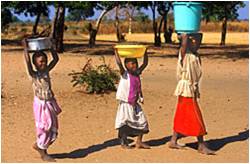
Do you take water for granted? Do you expect to have running water at home? Well that’s not something you should take for granted. I've lived without water for years on during the Lebanon civil war, and I can tell first-hand it made life extremely difficult.

At the moment, almost a billion people on the planet don’t have access to clean, safe drinking water. That means one-eighth of the world population is currently exposed to preventable disease, if not death, because of something that many of us fail to appreciate.

Water, the lifeblood of a nation, is being highlighted today in Blog Action Day 2010, which is an annual event held every October 15 that unites the world’s bloggers in posting about the same issue on the same day with the aim of sparking a global discussion and driving collective action. This year the issue is water.

Access to clean water is not just a human rights issue. It’s an environmental issue, an animal welfare issue and a sustainability issue. Water is a global issue that affects humanity altogether.
As at this writing, 4,437 bloggers from 133 countries are participating in highlighting the world’s most precious national resource that is indispensible for life. The White House and the UK Foreign Office will also be blogging about water on Blog Action Day today. The occasion is shaping up to be the biggest single day of action about clean water on record.

Blog Action Day brings to mind last year's Water Bucket Walk, when the UAE charity Dubai Cares invited the community to participate in the six-kilometer walk in support of children globally who do not have access to clean drinking water in schools.
Dubai Cares is a philanthropic establishment launched in September 2007 by His Highness Sheikh Mohammed Bin Rashid Al Maktoum, Vice President and Prime Minister of the United Arab Emirates and Ruler of Dubai, with the aim of improving access to primary education for children in developing countries.
Photo courtesy of Dubai Cares
According to Dubai Cares, children in developing countries walk on average more than six kilometers every day to collect polluted water that is likely to make them sick. The time spent daily collecting water can be quite lengthy, thus preventing many children from attending school.
Dubai Cares reports that children tend to leave their houses prior to sunrise to collect water. Once at a water source, they may queue for hours and, when they get their turn, the water may be so shallow that it would take them hours to scoop it into buckets. In addition, the water they scoop is often dirty and highly contaminated. These children then have to walk long and exhausting distances back to their houses carrying heavy buckets on their shoulders or heads.
Photo courtesy of Dubai Cares
According to the charity :
  • The average distance children in Asia and Africa have to walk to collect water is six kilometers (3 hours).
  •  Children miss 443 million schooldays every year due to contaminated water.
  •  Some 104 million children worldwide receive no education at all. Poor access to safe water and sanitation is a key cause.
  •  Most often it is the women and children who have to find water each day.
  •  Children miss school because they are walking long distances with buckets full of water that are not even safe enough to drink.
  •  Providing water, sanitation and hygiene reduces diarrheal deaths by 65 percent.
  • The simple act of washing hands with soap and water reduces diarrheal diseases by over 40 percent.
  •  Providing access to potable water within a one-kilometer range could create 320 million productive working days.
The Water Bucket Walk in Dubai (Dubai Cares)
The Water Bucket Walk, which took place on Dubai’s Jumeirah Beach Road, gave the community an opportunity to walk for a cause and experience a degree of the difficulties that children in developing countries tend to face with the burden of having to gather water for their families on a daily basis. The entry fee of AED 30, or $8, provided one child with clean drinking water for one year!

 We can make a difference for as little as that...
(Please take a moment to sign the petition above and support UN efforts to bring clean, safe water to millions. You can also visit change.org to join the discussion)