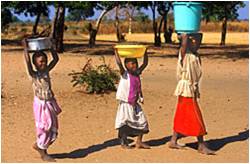

Today is International World Water Day to focus attention on the importance of freshwater and to campaign for the sustainable management of freshwater resources.
An international day to celebrate freshwater was recommended at the 1992 United Nations Conference on Environment and Development (UNCED). The UN General Assembly responded by designating March 22, 1993 as the first World Water Day. World Water Day 2012, under the theme “Water and Food Security,” is coordinated by the UN’s Food and Agriculture Organization (FAO).
I identify with World Water Day because I spent more than 10 years, during the Lebanon civil war, living with very little water. The “waste not, want not,” motto taught at home long before that, stood me in good measure then. We were brought up not to waste water, electricity and food, not for environmental reasons at the time, rather to save on bills.
When you have to use water, whether for bathing, washing, toilet flushing, cooking, cleaning etc… from a single bottle, you learn how to save. And this habit remains. I still don’t take a shower without appreciating running water.
My top tips would be: close the tap while brushing your teeth; make sure no taps are dripping; have a shower instead of a bath; fully load the washing machine or dishwasher before switching it on…

“Water and Food Security,” are intrinsically related as there are seven billion people to feed on the planet today and another two billion are expected to join by 2050. If only at one drop per person, that’s seven billion drops!
FAO statistics show that each of us drinks from two to four liters of water every day. However, most of the water we “drink” is embedded in the food we eat. Producing one kilo of beef for example consumes 15,000 liters of water while one kilo of wheat “drinks up” 1,500 liters.
When a billion people in the world already live in chronic hunger and water resources are under pressure we cannot pretend the problem is “elsewhere.” Coping with population growth and ensuring access to nutritious food to everyone call for a series of actions.
FAO says we can all help by:
- following a healthier, sustainable diet;
- consuming less water-intensive products;
- reducing the scandalous food wastage: 30% of the food produced worldwide is never eaten and the water used to produce it is definitively lost!
- producing more better quality food with less water.
At all steps of the supply chain, from producers to consumers, actions can be taken to save water and ensure food for all. FAO says it takes 2,000 to 5,000 liters of water to produce one person’s daily food intake. The world is thirsty because of our food needs.
 |
| Most of water we “drink” is embedded in food we eat |
To be able to feed everybody, we need to secure water in sufficient quantity and adequate quality. We also need to produce more food using less water, reduce food wastage and losses, and move towards more sustainable diets.
Food security exists when all people, at all times, have both physical and economic access to sufficient, safe and nutritious food that meets their dietary requirements for an active and healthy life. People who have better access to water tend to have better nourishment levels. Lack of water can be a major cause of famine and malnutrition, particularly in areas where people depend on local agriculture for food and income.
The UN General Assembly declared access to clean drinking water and sanitation as a human right on July 28, 2010. Access to safe and sufficient water is a human right under international law, and under some national constitutions.
Water scarcity affects every continent and more than 40 percent of the people on our planet. By 2025, 1.8 billion people will be living in countries or regions with absolute water scarcity, and two-thirds of the world’s population could be living under water-stressed conditions. The lack of water limits farmers’ ability to produce enough food to eat or earn a living. South Asia, East Asia and the Middle East for example are already close to their resources limits, and their population is still growing.

FAO adds that the gender gap in developing countries also plays a role as 43 percent of the farmers are women. But they are usually unable to perform well because of unequal access to services and resource inputs -- including water. If women had the same access to resources as men, they could increase yields on their farms by 20-30 percent. Closing this gender gap would lift 150 million people out of hunger.
Developing countries and emerging economies currently face a nutrition paradox with, on the one hand, high rates of undernourishment -- over 800 million hungry people worldwide -- and, on the other, about the same number who are overweight. Both undernourishment and obesity can lead to the risk of debilitating chronic diseases. Sustainable diets are diets with low environmental impacts, which contribute to food and nutritional security and to a healthy life for present and future generations.
Cutting food waste can feed the world. Roughly one third of the food produced in the world for human consumption every year -- approximately 1.3 billion tons -- gets lost or wasted, according to an FAO-commissioned study.
Key findings in the study include:
- Industrialized and developing countries dissipate roughly the same quantities of food -- respectively 670 and 630 million tons.
- Every year, consumers in rich countries waste almost as much food (222 million tons) as the entire net food production of sub-Saharan Africa (230 million tons).
- Fruits and vegetables, plus roots and tubers have the highest wastage rates of any food.

The amount of food lost or wasted every year is equivalent to more than half of the world's annual cereals crop (2.3 billion tons in 2009/2010).
Consumers in rich countries are generally encouraged to buy more food than they need, the study notes. "Buy three, pay for two" promotions are one example, while the oversized ready-to-eat meals produced by the food industry are another.
Consumers fail to plan their food purchases properly, the report found. That means they often throw food away when "best-before" dates expire.
Education in schools and political initiatives are possible starting points to changing consumer attitudes, the report suggests. Rich-country consumers should be taught that throwing food away needlessly is unacceptable. They should also be made aware that given the limited availability of natural resources it is more effective to reduce food losses than increase food production in order to feed a growing world population.
It takes me back to “waste not, want not…” This education should start at home.
Let’s try and save a drop a day and be careful about the food we buy and the food we throw away. On this second day of Spring, let’s help Mother Nature help us.