Pages

Showing posts with label Green Turtle. Show all posts

Wednesday, October 19, 2011

Abu Dhabi world wonder needs you

Bu Tinah Island (photo via www.butinah.ae/en/)
What are the seven things you can remember?

That’s what we will find out on November 11 after more than 100 million votes would have been cast to select what represents global heritage throughout history.

The Seven Ancient Wonders of the World were all man-made monuments, selected by Philon of Byzantium in 200 BC. Today, only the Pyramids of Giza in Egypt remain. His selection of wonders was essentially a travel guide for fellow Athenians, and the stunning sites were all located around the Mediterranean basin, the then-known world.

Today, rather than being chosen by one person, the New 7 Wonders of Nature will be picked by millions of people worldwide.

Bu Tinah Island, a UAE natural treasure, is the only finalist from the Arabian Gulf in the New 7 Wonders of Nature competition.

Building the Bu Tinah Experience dome on Abu Dhabi Corniche
The Bu Tinah dome at night (photo by Khaled Akbik)
If you have visited Abu Dhabi recently, you might be wondering what the giant white dome on the Corniche is. You’re in for a wonderful surprise.

It’s a project by the Environment Agency-Abu Dhabi (EAD) to bring Bu Tinah Island to the general public. It includes a turtle rehabilitation center and a mangrove nursery.

Off the western coast of the UAE capital, Bu Tinah is restricted to visitors, except for scientific research. It is a protected marine area where nature is respected and allowed to flourish. Bu Tinah is an important ecosystem that has thrived through protection of the island’s unique environment, and the conservation of its habitats and inhabitants.

Bu Tinah is part of the Marawah Marine Biosphere Reserve (MMBR), a UNESCO-recognized site and the region’s first and largest Marine Biosphere Reserve (MBR). Such sites are vital to promote more harmonious partnerships between natural and human activities. They are key to the future of sustainable development.

In 2007, the MMBR became the first site in the UAE to be recognized as a biosphere reserve. It covers an area of some 4,255 square kilometers and includes Marawah, Jenanah, Salahah, Al Buzm al Gharbi and Bu Tinah islands.

The MMBR is unique in that its inhabitants thrive under some of the highest temperatures and harshest living conditions in the world. Lessons on how to withstand global warming and climate change learned from this biosphere are highly relevant to the region and the world.

The UNESCO Man and the Biosphere (MAB) Program is a collaborative effort of scientific communities worldwide to study the relationship between humans and the environment and to provide solutions for global scientific, environmental, societal and developmental issues. Since being established in the 1970s, there are currently 580 biosphere reserves in 114 countries. These sites are essential to achieving sustainable development in future.

Bu Tinah Island Dugongs (www.butinah.ae/en/)
Bu Tinah Island has the highest density of Dugongs per square meter in the world. The Dugong, the island’s shyest character, is a gentile and graceful marine mammal also known as the Sea Cow.

One of Bu Tinah's Hawksbill turtles (www.butinah.ae/en/)
Green and Hawksbill turtles thrive on the island with three species of seagrass and over 21 species of marine algae. The endangered Hawksbill Turtle returns there every year to nest. Over 600 have been born on Bu Tinah this year alone, .

Model of the Socotra Cormorant in the dome
Several bird species spend their winters on the island. Osprey, the Western-reef Heron, and the Bridled and White-cheeked Tern stopover and breed there too. It is also where the Socotra Cormorant has found its home, with approximately 20,000 to 25,000 birds making it their annual retreat. There is a long stretch of mangroves along the backwaters that reach an average height of five meters.
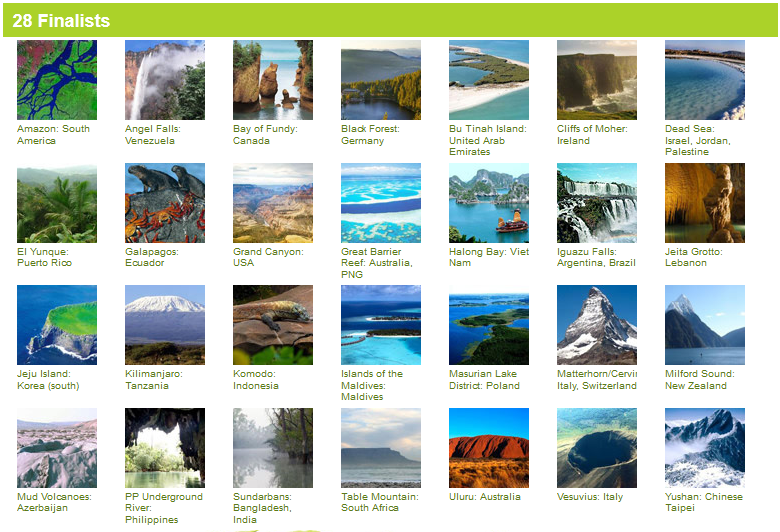
The New 7 Wonders of Nature finalists (new7wonders.com)
Bu Tinah has been shortlisted as a finalist from almost 500 sites of outstanding natural beauty from around the world in the environmental prize of prizes, known as the New 7 Wonders of Nature. The global campaign began in 2007 to vote for a new list of seven natural wonders. From 440 nominations, from over 220 countries, based on beauty of the nominated site, ecological substance, historical legacy and geographical location, the list was narrowed down to 77. It is now down to 28 finalists.

The competition closes on 11/11/11, so there is less than a month for a final push to support conservation and protect the UAE’s natural heritage by voting for Bu Tinah.

Because of the importance of conserving Bu Tinah, activities on and around the island are limited. That’s where the Bu Tinah Experience comes in – and the dome on the Abu Dhabi Corniche.

Model of a dolphin inside the Bu Thinah Experience dome
A turtle in the dome's lagoon (photo by Khaled Akbik)
The island has been recreated for people to catch sight of what life on Bu Tinah is like. This initiative by EAD is to raise awareness on the UAE’s biodiversity. Inside the dome there is a lagoon with live endangered turtles from UAE waters and a mangrove nursery. The turtles are part of a rehabilitation initiative that rescues injured animals before releasing them back in the areas they were found.

In the UAE, you can support Bu Tinah by sending an SMS with the word “BuTinah” to 3888 as many times as you like. Supporters around the world can also vote online on www.butinah.ae

EAD was established in 1996 to preserve Abu Dhabi’s natural heritage, protect the future, and raise awareness of environmental issues. It is Abu Dhabi’s environmental regulator and advises the government on environmental policy. It creates sustainable communities, and protects and conserves wildlife and natural resources.

EAD regularly monitors the turtles’ nesting and foraging habitats – providing vital information on clutch size, incubation period, hatching success and nesting patterns. It also investigates the species’ main causes of mortality in the region which have been identified as drowning in abandoned or illegal fishing nets (48%) followed by boat strikes (25%).

A robotic egg-laying turtle in the dome
Of the seven species of marine turtles in the world, two predominantly occur in Abu Dhabi’s waters: the critically endangered Hawksbill turtle (Eretmochelys imbricata) and the endangered Green turtle (Cheloniamydas mydas). Worldwide, the International Union for Conservation of Nature (IUCN) Red List classifies the Hawksbill turtle as “critically endangered.” In Abu Dhabi, turtles nest on at least 17 offshore islands from mid-March to mid-June.

The dome has an eco-cinema where visitors can view episodes of The Environment Show with Ask Ali series. The first episode was dedicated to the critically endangered Hawksbill turtle. A new episode of the series will be screened every week until November 13.

Ali Al Saloom introduces The Environment Show with Ask Ali
Each episode of the series will cover critical environmental issues of relevance to the Emirates. The series is part of a long-term collaboration project between EAD and Ali Al Saloom (better known as Ask Ali), EAD’s Environmental Awareness Ambassador and UAE cultural ambassador and columnist.

The dome is open to the public daily from 10 a.m. to 10 p.m. until November 13. Entrance is free.

If you haven’t voted yet, have a look at the video below!

 Good luck to the UAE and to Bu Tinah.

Related posts:
Turtles tutorial at Orange House – September 16, 2011

Friday, September 16, 2011

Turtles tutorial at Orange House

A visit to the Orange House Project in South Lebanon
On the spur of the moment, as it is so easy to do in Lebanon, my cousin Lillian and I decided to go to Tyre for Saturday lunch (September 4). We were joined by our friend Dunia Kabbani. On the road down South, we thought we would check on the Orange House Project.

That’s not recommended, but I had heard so much about this magical House and the turtle conservation plan it runs I thought it was worth a try. We were lucky to catch owner Mona Khalil at home and welcoming.

 The Orange House is about 20 minutes south of Tyre
The Orange House is a Bed and Breakfast, some 20 minutes south of Tyre, promoting an eco-tourism lodge and a turtle conservation effort. I had heard so much about it from friends who stay there often to get away from the city and help in the care of the turtles. It is also a wow on Facebook, where videos are often posted on hatchlings and their return to the sea.

Walking through the banana groves to get to the beach
The guesthouse itself is Mona’s family beachfront farm stretching from the main road, just before Kolaila and Mansouri, right down to the yet unspoiled beaches of the South. The five-minute walk to the waterfront is through the famous South Lebanon banana groves dotted with palm trees -- all heavily in fruit at this time of year.

From talking to Mona, checking out the project’s website and other research, it seems sea turtles swim to lay their eggs on beaches and it is by chance that she saw one swimming ashore in 1999. This led to a labor of love in trying to conserve those that come ashore in front of the house and to get the shores of South Lebanon internationally branded turtle conservation areas.
 
The “labor” part of the “love” involves keeping the beach clean and daily surveying to gather data during the nesting season from May to September. It also requires relocating nests threatened by agriculture runoff or sea flooding and installing metal grids to protect them from predators.

Guests have the privilege of helping Mona and her team, But be warned, the turtles swim ashore during the night but also go back to sea at daybreak. This means the team has to be out by 3-or-4 a.m. until 6 a.m., when all the turtles and hatchlings have all headed back to sea.

A turtle eggshell, the size of a ping-pong ball
Scattered eggshells from the morning's hatchlings
Sea turtles take 20 to 30 years to be of age to lay eggs. Even if information about the lifespan of sea turtles is motley, it is thought that they live up to 70-80 years. Mona relates that females return to nest at the same beach where they were born. They do that up to two to four times a season every two or three years. Nests typically contain on average 100 soft-shelled eggs. Around one hatchling per 1,000 reaches adult age. The turtle can lay around 70 eggs at a time.

The B&B and eco-tourism venture is mostly to help raise funds for the project that has been adopted by countless people locally and internationally.

Flowers growing on the beach
Keeping the beach clean is vital and a daily effort, says Mona. The turtles are threatened by plastic bags, hospital waste, factory chemicals and fertilizer run-off from farms in the region. Plastic bags in the water can suffocate turtles, which mistake them for jellyfish and try to eat them. 

During the nesting season, the team tries to find the eggs, which need 45 to 65 days to hatch. The nests are protected from dogs and foxes by a metal grid. As we visited late in the morning, we couldn’t see any turtles, but Ali, a member of the team, showed me that morning’s empty nests that still had some eggshells the size of ping-pong balls.

The upstairs guest terrace
One of the Orange House guest rooms
Orange House has three double rooms for guests on the second floor of the farmhouse. For $50 per person a night, it is an excellent way to escape the hustle and bustle of the city and relax in the magical gardens and terraces of Orange House. There is a kitchen for guests to prepare meals or they can go to the many restaurants of Tyre.

Mona and her team were trained by the Mediterranean Association to Save the Sea Turtles (MEDASSET). Her aim is to persuade the Lebanese government to declare the beach at Mansouri and Kolaila a national nature reserve. The local municipalities have already recognized Mansouri and Kolaila beach.

Although we didn’t want to take up too much of Mona’s time, as she had been up since 4 a.m., she still kindly explained about the two species she comes across and regularly nest on the beaches of South Lebanon and along the Mediterranean. They are the Green Turtles (Chelonia mydas) and Loggerheads (Caretta caretta).

The Green Turtle lives for 60 to 100 years. It can grow to 1.60 meters long and one meter wide. It weighs at least 360 kg. A vegetarian, it feeds on sea grass. The Loggerhead Turtle has a larger head but its body is smaller at little more than a meter long and weighs around 160 kg. Loggerheads use their powerful beaks to break the shells of crustaceans, mollusks and urchins. They also eat fish, algae and seaweed.

Prickly pears...
... and marrows growing between the banana groves
We walked down to the beach through the banana groves and palm trees with marrows growing between. I hadn’t seen marrows in groves for a longtime and it is a great favorite of this season. The shoots, leaves and tendrils of the creeper can be eaten as greens and its flowers often mixed in salads.

I couldn't stop picking and eating jujube
The garden is full of citrus fruit
The resident Orange House goats
After admiring the coast and the startling blue Mediterranean, we walked back to the house, passing the goats and admiring the garden full of citrus fruit and even a Flame Tree. I couldn’t believe it when I spotted jujube trees. I hadn’t had any jujube for at least 25 years and couldn’t stop picking and eating some direct from the branches.

Lillian, Dunia and Mona
Although guests were arriving to spend the day at the Orange House beach, Mona still found time to offer us coffee and sit with us. She showed us photos and hatchlings that didn’t make it and are preserved in jars.

We then got a tour of the second floor houseguest area before thanking her profusely for taking the time to show us around. Pictures captured on my camera can take you on a “virtual tour” of Orange House.

After taking leave we headed back to Tyre for lunch and a visit to the old city’s ruins. But that’s for the next post.

A weekend at Orange House is something I hope to do on one of my next trips to Lebanon.
Enhanced by Zemanta