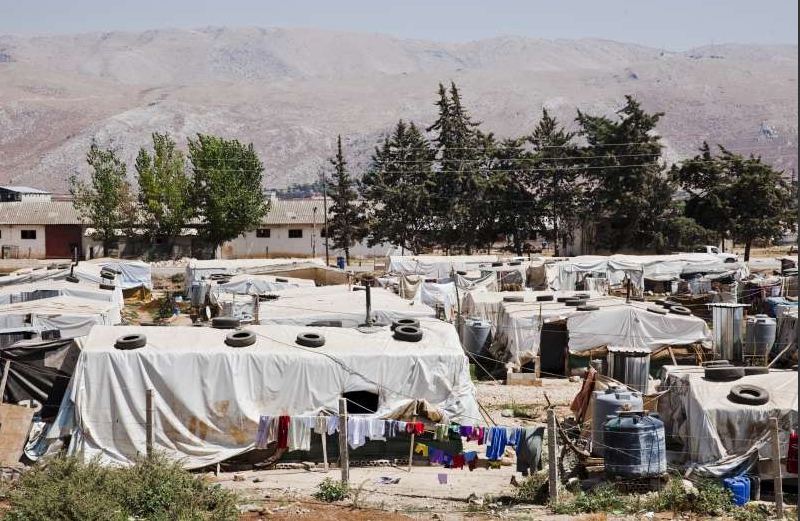
Soar to almost 900,000 in industrialized world, says UNHCR

The
UN refugee agency (UNHCR) reported last Thursday (March 26) that the wars in
Syria and Iraq, as well as armed conflicts, human rights violations and
deteriorating security and humanitarian conditions in other countries, pushed
the number of asylum applications in industrialized countries to a 22-year high
last year.
And there is no end in sight...
And there is no end in sight...
A combination of armed conflict, deterioration of security or
humanitarian situation and human rights concerns in a number of countries -- notably
Syria -- have been among the main reasons for the sharp increase in the number
of asylum-seekers registered among industrialized countries during 2014.
An estimated 866,000 asylum applications were recorded in the
course of the year, some 269,400 claims more than the year before (+45%). This
is the fourth consecutive annual increase and the second highest annual level
since the early 1980s when statistics on asylum-seekers started being collected
by UNHCR in a systematic way. As such, the 2014 figure is close to the all-time
high of almost 900,000 asylum applications recorded among the industrialized
countries in 1992.
UNHCR’s report,
The
Asylum Trends 2014, puts the
estimated number of new asylum applications lodged in industrialized countries
throughout the year at 866,000, a 45 percent increase from 2013, when 596,600
claims were registered. The 2014 figure is the highest since 1992, at the
beginning of the conflict in Bosnia and Herzegovina.
UN
High Commissioner for Refugees António Guterres put the new figures in their
historical context. "In the 1990s, the Balkan wars created hundreds of
thousands of refugees and asylum seekers," Guterres said. "Many of
them found refuge in industrialized countries in Europe, North America and
elsewhere.
"Today,
the surge in armed conflicts around the world presents us with similar
challenges, in particular the dramatic situation in Syria. Our response has to
be just as generous now as it was then -- providing access to asylum,
resettlement opportunities and other forms of protection for the people fleeing
these terrible conflicts."


UNHCR’s
report says Syrians were by far the largest group among those seeking asylum in
2014, with almost 150,000 applications, one in every five asylum claims in the
industrialized world. Iraqis accounted for 68,700 applications, almost double
the number in 2013. Afghans were the third largest group, with almost 60,000
applications, followed by citizens of Serbia (and Kosovo) and Eritreans.
The
industrialized country receiving the largest number of asylum-seekers in 2014
was Germany, with more than 173,000 applications. Syrians made up a quarter of
all asylum applications in Germany. The United States received an estimated
121,200 asylum claims, mostly from Mexico and countries in Central America.
Turkey,
which by the end of last year hosted over 1.5 million Syrian refugees, received
87,800 new asylum applications in 2014, mainly from Iraqis. Sweden ranked
fourth among the 44 industrialized countries, with 75,100 applications, mainly
from Syrians and Eritreans. Italy registered 63,700 new applications in 2014,
the highest on record. Asylum-seekers in Italy came mainly from Mali, Nigeria
and Gambia.
The
Russian Federation, which is not included in this report for methodological
reasons, received some 265,400 applications for temporary asylum and 5,800
applications for refugee status from Ukrainians during 2014. At the same time,
the number of Ukrainians seeking asylum in the 44 countries included in the
report went up from 1,400 in 2013 to 15,700 in 2014.
While
there has been a net overall increase in asylum applications, the number of new
claims has not been spread evenly among the industrialized countries covered by
the report. The top five receiving countries (Germany, the United States,
Turkey, Sweden and Italy), for example, accounted for 60 percent of all new
asylum claims.

The
report reveals other disparities, as when a country's population size is taken
into account, for example. Relative to the size of its population, Sweden is
the country with the largest number of asylum seekers (24.4 asylum seekers per
1,000 inhabitants on average, during the last five years), followed by Malta,
Luxembourg, Switzerland and Montenegro.
While
most industrialized countries saw increases in the number of asylum applicants
during last year, some countries registered a decrease, notably Australia,
where numbers went down 24 per cent from 11,700 in 2013 to less than 9,000 in
2014.
UNHCR's
Asylum Trends 2014 report is based on data received from 44 governments in
Europe, North America and parts of the Asia-Pacific. The number of people
applying for refugee status in industrialized countries is just one element in
the global picture of forced displacement from conflict and persecution.
Worldwide,
by the start of last year, some 51.2 million individuals were forcibly
displaced as a result of persecution, conflict, generalized violence or human
rights violations. Of these, some 16.7 million people were refugees and 33.3
million were internally displaced in their own country. Close to 1.2 million
were asylum-seekers. UNHCR's forthcoming Global Trends 2014 report, due in June
2015, will provide a complete picture of global displacement in 2014.
The
Asylum Trends 2014 report and annex tables are available here:
Annexes [Excel
tables -zip file]