Pages

Showing posts with label UNHCR. Show all posts

Saturday, April 11, 2015

Thank you IKEA for shining a light on refugees


For every LED light bulb sold in IKEA stores between February and March 2015, the IKEA Foundation donated €1 (AED3.88) to UN refugee agency (UNHCR) to light refugee camps -- making them a safer, more suitable place for the many families who live there.

Under its “Brighter Lives for Refugees” campaign, the IKEA Foundation drive in the global retailer's stores has so far this year raised €10.8 million (AED 42 million) that will improve the lives of refugees by providing educational opportunities and distributing renewable energy devices such as solar lights, UNHCR said in a statement on Friday (April 10).
The funds will help improve the lives of 380,000 refugees in Bangladesh, Chad, Ethiopia and Jordan.
"Thanks to IKEA's co-workers and customers, thousands of refugee children and families will now have access to sustainable energy and lighting," said Per Heggenes, CEO of the IKEA Foundation. "Simple activities like sharing a family meal, doing homework and important social gatherings will now be possible for some of the most vulnerable people on our planet."
The campaign, which began in 2014, raised €7.7 million (AED30 million) last year. Already thousands of refugees have benefited.
In Jordan, some 11,000 Syrian refugees living in Azraq camp can move around safely after 500 solar streetlights and LED streetlights were installed. In refugee camps around Dollo Ado in Ethiopia, 40,000 solar lanterns -- one per refugee family -- and 240 streetlights are being delivered. In Chad, over 13,000 refugee children have been enrolled in primary school.
"The number of displaced people worldwide has, for the first time since World War II, exceeded 50 million people, including 13 million refugees who are under UNHCR's care," said UN Deputy High Commissioner for Refugees T. Alexander Aleinikoff. About half are children.
"In this context, the engagement of the public worldwide through our long-standing partner, the IKEA Foundation, has never been more important. I greatly appreciate the efforts of IKEA co-workers and the support of the customers who participated in this global campaign so that we can make the lives of thousands of refugees better and brighter," Aleinikoff said.

A lack of light in refugee camps after sunset can have a devastating effect on safety and security. The loss of daylight means that even simple activities like using the toilet, collecting water or returning to the shelter can become dangerous, particularly for women and girls. The campaign focuses on providing renewable energy solutions like solar-powered streetlights, solar-powered lanterns and fuel-efficient cooking stoves that make camps safer and more comfortable.
Providing sustainable lighting can have a huge effect on the quality of life in a refugee camp:
  • Solar lanterns help children study after dark, improving results in school.
  • Solar street lights enable people to have more community gatherings and social activities.
  • Solar lanterns allow refugees to continue important income-generating activities, such as weaving or sewing, long after the sun goes down.
  • Solar lanterns enable refugees to run their small shops and kiosks into the evening so they can earn a sustainable income.
The IKEA Foundation has partnered with UNHCR since 2010, helping to provide shelter, care and education in refugee camps and surrounding communities. The Foundation has to date committed more than €125 million (AED486 million) in support to UNHCR.


Monday, March 30, 2015

Asylum applications at a 22-year high

Soar to almost 900,000 in industrialized world, says UNHCR

The UN refugee agency (UNHCR) reported last Thursday (March 26) that the wars in Syria and Iraq, as well as armed conflicts, human rights violations and deteriorating security and humanitarian conditions in other countries, pushed the number of asylum applications in industrialized countries to a 22-year high last year.

And there is no end in sight...

A combination of armed conflict, deterioration of security or humanitarian situation and human rights concerns in a number of countries -- notably Syria -- have been among the main reasons for the sharp increase in the number of asylum-seekers registered among industrialized countries during 2014.

An estimated 866,000 asylum applications were recorded in the course of the year, some 269,400 claims more than the year before (+45%). This is the fourth consecutive annual increase and the second highest annual level since the early 1980s when statistics on asylum-seekers started being collected by UNHCR in a systematic way. As such, the 2014 figure is close to the all-time high of almost 900,000 asylum applications recorded among the industrialized countries in 1992.

UNHCR’s report, The Asylum Trends 2014, puts the estimated number of new asylum applications lodged in industrialized countries throughout the year at 866,000, a 45 percent increase from 2013, when 596,600 claims were registered. The 2014 figure is the highest since 1992, at the beginning of the conflict in Bosnia and Herzegovina.

UN High Commissioner for Refugees António Guterres put the new figures in their historical context. "In the 1990s, the Balkan wars created hundreds of thousands of refugees and asylum seekers," Guterres said. "Many of them found refuge in industrialized countries in Europe, North America and elsewhere.

"Today, the surge in armed conflicts around the world presents us with similar challenges, in particular the dramatic situation in Syria. Our response has to be just as generous now as it was then -- providing access to asylum, resettlement opportunities and other forms of protection for the people fleeing these terrible conflicts."


UNHCR’s report says Syrians were by far the largest group among those seeking asylum in 2014, with almost 150,000 applications, one in every five asylum claims in the industrialized world. Iraqis accounted for 68,700 applications, almost double the number in 2013. Afghans were the third largest group, with almost 60,000 applications, followed by citizens of Serbia (and Kosovo) and Eritreans.

The industrialized country receiving the largest number of asylum-seekers in 2014 was Germany, with more than 173,000 applications. Syrians made up a quarter of all asylum applications in Germany. The United States received an estimated 121,200 asylum claims, mostly from Mexico and countries in Central America.

Turkey, which by the end of last year hosted over 1.5 million Syrian refugees, received 87,800 new asylum applications in 2014, mainly from Iraqis. Sweden ranked fourth among the 44 industrialized countries, with 75,100 applications, mainly from Syrians and Eritreans. Italy registered 63,700 new applications in 2014, the highest on record. Asylum-seekers in Italy came mainly from Mali, Nigeria and Gambia.

The Russian Federation, which is not included in this report for methodological reasons, received some 265,400 applications for temporary asylum and 5,800 applications for refugee status from Ukrainians during 2014. At the same time, the number of Ukrainians seeking asylum in the 44 countries included in the report went up from 1,400 in 2013 to 15,700 in 2014.

While there has been a net overall increase in asylum applications, the number of new claims has not been spread evenly among the industrialized countries covered by the report. The top five receiving countries (Germany, the United States, Turkey, Sweden and Italy), for example, accounted for 60 percent of all new asylum claims.


The report reveals other disparities, as when a country's population size is taken into account, for example. Relative to the size of its population, Sweden is the country with the largest number of asylum seekers (24.4 asylum seekers per 1,000 inhabitants on average, during the last five years), followed by Malta, Luxembourg, Switzerland and Montenegro.

While most industrialized countries saw increases in the number of asylum applicants during last year, some countries registered a decrease, notably Australia, where numbers went down 24 per cent from 11,700 in 2013 to less than 9,000 in 2014.

UNHCR's Asylum Trends 2014 report is based on data received from 44 governments in Europe, North America and parts of the Asia-Pacific. The number of people applying for refugee status in industrialized countries is just one element in the global picture of forced displacement from conflict and persecution.

Worldwide, by the start of last year, some 51.2 million individuals were forcibly displaced as a result of persecution, conflict, generalized violence or human rights violations. Of these, some 16.7 million people were refugees and 33.3 million were internally displaced in their own country. Close to 1.2 million were asylum-seekers. UNHCR's forthcoming Global Trends 2014 report, due in June 2015, will provide a complete picture of global displacement in 2014.

The Asylum Trends 2014 report and annex tables are available here:

Annexes [Excel tables -zip file]

Monday, February 24, 2014

UNHCR urges world access to 100,000 Syrians in 2015/16


A Syrian boy at a refugee transit site in Arsal, Lebanon (UNHCR/M. Hofer)
With  no end in sight to the three-year fighting in Syria, the UN refugee agency on February 21 called upon countries around the world to make multi-annual commitments towards a goal of providing resettlement and other forms of admission for an additional 100,000 Syrian refugees in 2015 and 2016.

UNHCR had earlier called upon states to offer resettlement or other forms of admission to 30,000 of the most vulnerable Syrian refugees by the end of 2014. To date, 20 countries have offered more than 18,800 places towards this goal.
There are currently more than 2.4 million refugees registered in the region. In Lebanon there are some 932,000, Jordan has 574,000, Turkey some 613,000, Iraq 223,000 and Egypt has about 134,000 refugees.
"UNHCR remains confident that the 30,000 goal will be met by the end of the year through a significant number of submissions to the United States," spokesman Dan McNorton told journalists in Geneva.
As part of the emergency response, UNHCR is urging states to consider a number of solutions that can provide secure, urgent and effective protection for these people. Such solutions could include resettlement, humanitarian admission or individual sponsorship; programs that enable Syrian relatives to join family members; scholarships for Syrian students in order to prevent a "lost generation" of young people; and medical evacuation for refugees with life-threatening health conditions.
Arsal, Lebanon
More than 10,000 Syrians have fled over the mountains into Lebanon since a fresh offensive on the city of  Yabroud – in Reef Dimashq governorate about 80 km north of Damascus -- and     its outskirts began in mid February. The new arrivals represent a second wave of refugees to escape fighting in the same region of Syria, following an earlier influx in November 2013.
Syrian refugee tents in Arsal (The Daily Star/Hassan Shaaban)
The new refugees are arriving in a town that has already taken in huge numbers in recent months. The population of Arsal, normally 35,000, has now surpassed 83,000 – with far more Syrians now than Lebanese.
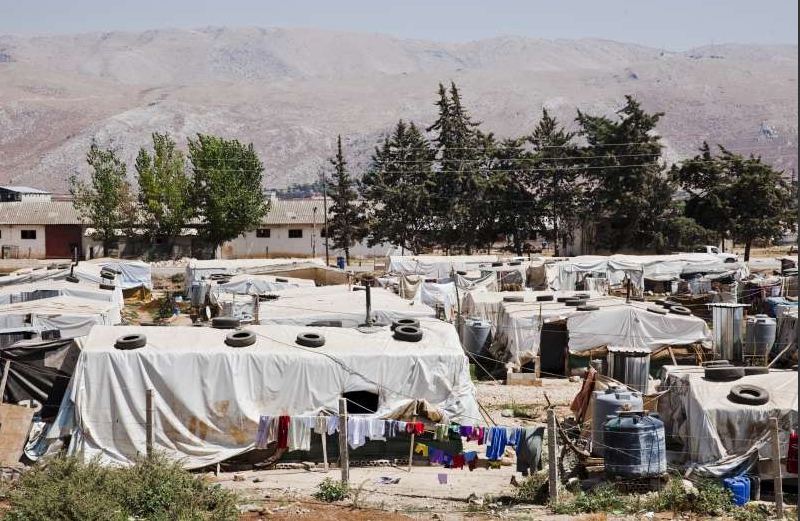
Community centers, mosques and other "collective shelters" have long since run out of space. Across the town, a patchwork of blue and white tents and impromptu shelters is filling up any open space. Some new arrivals are living in vans and the backs of trucks. With this new influx, the number of informal tented settlements in the town has climbed from six to more than 30, writes UNHCR’s Andrew Purvis from Arsal.
The latest exodus from Syria began in earnest when bombing intensified on February12.
To avoid shelling, many of those fleeing Yabroud are finding alternative routes over the mountains along rugged mountain tracks still blanketed with snow.
For many of the refugees, the escape to Lebanon follows several years of displacement and deprivation within Syria.

Sunday, December 15, 2013

Does Santa exist for Syria’s children?

Despite the freezing cold, children will be children... (via telegraph.co.uk)
Most people, especially children, hope for a White Christmas. It is certainly not the wish of over 1.1 million Syrian children, now scattered across their own country or taking refuge in neighboring Lebanon, Jordan, Turkey and Iraq.
With Christmas just over a week away, most families are now filling bags of gifts for their children, decorating their homes, putting up Christmas trees and stocking up on food for the festive season.
In the Middle East, and especially in Syria and Palestine, children will not even know it’s that time of year.
In Syria, in particular, where over half of all 2.3 million refugees are children, will this shameful milestone of conflict deliver more than headlines?
Nowhere else to sleep...
Why is it that the human heart and conscience remains blank and cold in the face of the tragedy of these kids? Why are there no more initiatives such "Do They Know It's Christmas?" in 1984 and Live Aid in 1985?
The UN refugee agency UNHCR is stepping up measures to protect the hundreds of thousands of Syrian refugees in Lebanon, including 120,000 living in flimsy tents, as they face the onslaught of a massive winter storm in the region dubbed “Alexa.”
"For the hundreds of thousands of refugees in Lebanon, as well as those in neighboring countries and the displaced in Syria, a storm like this creates immense additional hardship and suffering," said Amin Awad, director of UNHCR's Middle East and North Africa Bureau. "With Lebanon's help, we're doing everything we can to get rapid additional help to people who most need it. This is on top of the winter preparations already done over the past months."
A host of other humanitarian agencies are working on the winter response in Lebanon, including the World Food Program, the Norwegian Refugee Council, the International Organization for Migration, Oxfam, Medair, Save the Children, World Vision, Humedica, Mercy Corps, Caritas and Handicap International.
Lebanon is now the largest Syrian refugee-hosting country in the region, with almost 840,000 Syrians either registered as refugees or awaiting registration, according to UNHCR. Unlike other countries neighboring Syria, there are no established refugee camps. Instead people are living in the community in nearly 1,600 different areas.
Before the storm hit last week, UNHCR undertook a research project, conducted over four months, on what life is like for Syrian children in the two countries hosting the highest number of Syrian refugees -- Jordan and Lebanon.
The Future of Syria: Refugee Children in Crisis found that Syrian refugee children face a startling degree of isolation and insecurity. If they aren’t working as breadwinners -- often doing menial labor on farms or in shops -- they are confined to their homes.
Perhaps the statistic we should pay the most attention to, says UNHCR, is: 29 percent of children interviewed said they leave their home once a week or less. Home is often a crammed apartment, a makeshift shelter or a tent.
Too many have been wounded physically, psychologically or both. Some children have been drawn into the war -- their innocence ruthlessly exploited.
A grave consequence of the conflict is that a generation is growing up without a formal education. More than half of all school-aged Syrian children in Jordan and Lebanon are not in school. In Lebanon, it is estimated that some 200,000 school-aged Syrian refugee children could remain out of school at the end of the year.
The Arsal makeshift Syrian refugee camp in northeast Lebanon
Another disturbing symptom of the crisis is the vast number of babies born in exile who do not have birth certificates.
A recent UNHCR survey on birth registration in Lebanon revealed that 77 percent of 781 refugee infants sampled did not have an official birth certificate. Between January and mid-October 2013, only 68 certificates were issued to babies born in Jordan’s Zaatari refugee camp.
How is this allowed to happen? (via yallasouriya.wordpress.com)
Much more needs to be done if a catastrophe is to be averted, says UNHCR, including:
Keep the borders open: For all the problems identified in the report, children have access to protection because countries like Lebanon and Jordan have welcomed them. No effort should be spared in supporting Syria’s neighbors to keep their borders open. Further afield, in the past few months, many adults and children have lost their lives attempting to reach Europe. States must do more to ensure the safety of people attempting to cross water and land borders.
Help the neighbors: The unwavering commitment of neighboring countries to tackle the monumental task of supporting hundreds of thousands of Syrian refugee children must be matched by international solidarity. Overstrained school systems must be built up, health services expanded and local communities reassured that support is available for them too.
Stop recruitment and exploitation of children: Children should never be drawn into conflict. All parties should make every effort to end this practice.
Expand resettlement and humanitarian admissions programs for Syria’s children: Countries beyond Syria’s borders should also offer a home to Syrian refugees. These programs are important lifelines for the most vulnerable, including people who continue to be in danger and families with seriously wounded children. Unaccompanied and separated children are only considered for these programs after a careful examination of their best interests.
Provide alternatives so children do not have to work: We urge individuals and businesses to help fund UNHCR’s financial assistance scheme that targets vulnerable refugee families and call on governments to explore alternative livelihoods opportunities for Syrian refugees.
Prevent statelessness: Lack of a birth certificate or related documentation can increase the risk of statelessness and expose children to trafficking and exploitation. Returning home may be impossible for children without the necessary documentation. Progress is already being made in neighboring countries, but it is vital that host countries continue to improve access to birth registration.
A few of the 1.1 million Syrian refugee children trying to keep warm
Of the 1.1 million Syrian children registered as refugees with UNHCR worldwide, some 75 percent are under the age of 12. Children represent 52 percent of the total Syrian refugee population, which now exceeds 2.2 million. The majority live in Syria’s neighboring countries, with Jordan and Lebanon combined hosting more than 60 percent of all Syrian refugee children. As of 31 October 2013, 291,238 Syrian refugee children were living in Jordan and 385,007 in Lebanon.
The war in Syria has torn families apart, with over 3,700 children in Jordan and Lebanon living without one or both of their parents, or with no adult caregivers at all. By the end of September 2013, UNHCR had registered 2,440 unaccompanied or separated children in Lebanon and 1,320 in Jordan. In some cases the parents have died, been detained, or sent their children into exile alone out of fear for their safety.
UN agencies and partners help to find safe living arrangements for unaccompanied and separated children, reuniting them with their families or finding another family to look after them. Despite living in already crowded conditions, Syrian refugee families continue to open up their homes to relatives or even strangers.
The unrelenting exodus of Syrian refugees to Jordan and Lebanon is having a dramatic impact on these small countries. Lebanon, with a population of a little more than 4 million, has received more than 800,000 Syrian refugees in two years. The economy, essential services and stability of the country are all suffering.
Jordan, one of the most “water poor” nations in the world, with a population of a little over 6 million, is now home to more than 550,000 Syrian refugees. It is also buckling under the pressure on its services, infrastructure and resources.
While many Jordanians and Lebanese display kindness and generosity towards Syrian refugees, tensions between the communities -- and even within refugee communities -- have put refugee children at risk.
Has the world changed so much since the 1980s? Have we become immune to suffering, even that of children?
Maybe Santa doesn't exist after all…

Friday, August 23, 2013

Shame, as we fail the children of Syria

A Syrian child refugee, one of one million (Photo via UNHCR)
“Does the world care?"

“Can we forget?”

“Can we forgive you for ignoring us?”

Questions this little girl -- one of one million Syrian refugee children -- seems to be asking us.

Since the beginning of the war in Syria in March 2011, one of the most devastating facts -- after the loss of life -- is the figures for the living.

UNHCR, the UN Refugee Agency, estimates there are now more than one million Syrian children living outside their country as refugees out of almost two million people who have fled Syria to escape the bloody war.

In a statement released today in Geneva, UNHCR says one million Syrian children have now been registered as refugees.

"What is at stake is nothing less than the survival and well-being of a generation of innocents," António Guterres, UNHCR High Commissioner said.

"The youth of Syria are losing their homes, their family members and their futures. Even after they have crossed a border to safety, they are traumatized, depressed and in need of a reason for hope,” he added.

According to UNHCR and UNICEF, “Children make up half of all refugees from the Syria conflict. Most have arrived in Lebanon, Jordan, Turkey, Iraq and Egypt. Increasingly, Syrians are fleeing to North Africa and Europe. Latest figures show that of the one million Syrian refugees under the age of 18, some 740,000 are children under the age of 11.”


"This one millionth child refugee is not just another number," UNICEF Executive Director Anthony Lake said in New York. "This is a real child ripped from home, maybe even from a family, facing horrors we can only begin to comprehend."

"We must all share the shame," said Lake, "because while we work to alleviate the suffering of those affected by this crisis, the global community has failed in its responsibility to this child. We should stop and ask ourselves how, in all conscience, we can continue to fail the children of Syria."

Inside Syria, according to the Office of the High Commissioner for Human Rights, some 7,000 children have been killed during the conflict. UNHCR and UNICEF estimate that more than two million children have been internally displaced within Syria.

The UNHCR statement says, “The physical upheaval, fear, stress and trauma experienced by so many children account for just part of the human crisis.”

Dalhamiyeh camp for Syrian refugees in Lebanon's Bekaa Valley (UNHCR/S. Baldwin)
It adds that both UNHCR and UNICEF highlight the threats to refugee children from child labor, early marriage and the potential for sexual exploitation and trafficking. More than 3,500 children in Jordan, Lebanon and Iraq have crossed Syria's borders either unaccompanied or separated from their families.

UNHCR has registered all one million children, giving them an identity. The agency helps babies born in exile get birth certificates, preventing them from becoming stateless. UNHCR also ensures that all refugee families and children live in some form of safe shelter.

But more remains to be done, said the two agencies. The Syria Regional Refugee Response plan, which calls for $3 billion to address the acute needs of refugees until December 2013, is currently only 38 percent funded.

More than $5 billion has been called for to address the Syria crisis, with critical needs in education, health care and other services for children and child members of host communities. More resources need to be devoted to developing strong networks to identify refugee children at risk and to provide them, and their host communities, with support.

More funds are only part of the response needed to address children's needs, the UN agencies said.

Those who fail to meet these obligations under international humanitarian law should be held fully accountable for their actions, UNHCR and UNICEF said.

Thursday, June 20, 2013

World Refugee Day: Take 1 minute…

A refugee is someone who “owing to a well-founded fear of being persecuted for reasons of race, religion, nationality, membership of a particular social group, or political opinion, is outside the country of his/her nationality, and is unable to or owing to such fear, is unwilling to avail himself of the protection of that country…”
More people around the world are refugees or internally displaced than at any time since 1994, with the crisis in Syria having emerged as a major new factor in global displacement.
The UN High Commissioner for Refugees (UNHCR) annual Global Trends report released yesterday, ahead of World Refugee Day, shows that as at the end of 2012, more than 45.2 million people were in situations of displacement compared to 42.5 million at the end of 2011.
This includes 15.4 million refugees, 937,000 asylum seekers, and 28.8 million people forced to flee within the borders of their own countries.
The report does not include the rise in those forced from their homes in Syria during the current year. Significant new internal displacement was seen in the Democratic Republic of Congo and Syria.
A full 55% of all refugees listed in UNHCR's report come from just five war-affected countries: Afghanistan, Somalia, Iraq, Syria and Sudan.
Afghanistan remained the world's biggest source of refugees, a position it has now held for 32 years, with 95% of Afghan refugees located in either Iran or Pakistan.
Somalis were the second biggest group of refugees in 2012, followed by Iraqis. Syrians were the fourth biggest group.
The figures do not, however, reflect the additional one million people who have fled Syria in the last six months.
Syrian refugees children (via www.un.org)
According to the UNHCR report conflict in Syria has "forced 647,000 people to flee mainly to neighboring countries. This was the largest annual exodus by a single refugee group since 1999, when more than 867,000 people fled Kosovo."
The number of internally displaced persons is at the highest level in more than 20 years, with the war in Syria leading to 4.25m Syrians being internally displaced.
The UN says if current trends persist, a further two million people will have left Syria by the end of this year.
It also found that developing countries now hosted 81% of the world's refugees, 11% more than a decade ago.
Children below age 18 make up 46% of all refugees. In addition, a record 21,300 asylum applications submitted during 2012 were from children who were unaccompanied or separated from their parents. This is the highest number of unaccompanied or separated children that UNHCR has recorded.
"These truly are alarming numbers. They reflect individual suffering on a huge scale and they reflect the difficulties of the international community in preventing conflicts and promoting timely solutions for them," said António Guterres, UN High Commissioner for Refugees and head of UNHCR.
The report highlights worrisome trends, including the rate at which people are being forced into situations of displacement. During 2012 some 7.6 million people became newly displaced, 1.1 million as refugees and 6.5 million as internally displaced people. This translates to a new refugee or internally displaced person every 4.1 seconds.
"Each time you blink another person is forced to flee," Guterres said.
Of 10.5 million refugees under UNHCR's mandate -- a further 4.9 million Palestinian refugees fall under the mandate of its sister-agency, the UN Relief and Works Agency (UNRWA).
A refugee will always yearn to return. The key to the abandoned home is often the symbol of that hope.
My uncle, until he died before returning to Palestine, kept the key to his Haifa home hanging next to the front entrance of his Beirut residence. He would bring the key down before Sunday lunch to make sure it wasn’t rusty or anything.
World Refugee Day is held every year on June 20 to recognize the resilience of forcibly displaced people throughout the world.
It was established by the United Nations to honor the courage, strength and determination of women, men and children who are forced to flee their homes under threat of persecution, conflict and violence.
This year, UNHCR continues its award-winning "1" campaign with its first ever personal fundraising. It asks us to Take 1 minute to support a family forced to flee.
On World Refugee Day 2013, the focus is on the impact of conflict on families through the theme of “1 Family Torn Apart by War is Too Many.” The spotlight is also on ways of helping those who are forced to flee to find safety, regain hope and rebuild their lives.
In 1 minute, a family can be torn apart by war, a child can be separated from his or her parents and a lifetime of work can be destroyed.
Yet in 1 minute, the world community can also act -- reuniting a family, protecting a child, providing shelter, UNHCR says.
Kinan's page at UNHCR site
My friend Kinan took “1” minute and set up a page to help on Facebook. He says: “Hi everyone. I've set up a donation page to help support ONE refugee family. Chip in whatever you can. As little as $17 can provide this family basic kitchen equipment so they could have some noms [food]. And a $50 will allow them to sleep nice and warm after they've had their noms. For them to have everything back – food, shelter, tent, etc – we need a total $670. So the little donations will pile up and we can do this!”
It takes 1 minute to lose everything... A Syrian refugee family (via UNHCR)
Often classified unfairly with economic migrants, refugees flee their country not for economic gain but to escape persecution, the risk of imprisonment and threats to their lives. They need a safe haven where they can recover from mental and physical trauma and rebuild their hopes for a better future.
The intolerance that is often at the root of internal displacement and refugee flows is also present in some of the countries refugees flee to. Instead of finding empathy and understanding, they are often met with mistrust or scorn.
The UN General Assembly, on 4 December 2000, adopted resolution 55/76 where it noted that 2001 marked the 50th anniversary of the 1951 Convention relating to the Status of Refugees, and that the Organization of African Unity (OAU) had agreed to have International Refugee Day coincide with Africa Refugee Day on 20 June. The General Assembly therefore decided that 20 June would be celebrated as World Refugee Day.
Ahead of the G8 meeting in Ireland earlier this week, Carolyn Miles, President and CEO of Save the Children, made an appeal to world leaders to save the children of Syria to coincide with World Refugee Day.
“Time is running out for millions of children across Syria,” Miles said. “The G8 leaders must send a strong signal to the world that the appalling humanitarian crisis in the country and region is a global priority. Aid agencies like Save the Children can only reach 10% of people we aim to help inside Syria.
“We urgently need better access; we know that children are being tortured, have little medical help and have witnessed family members being killed in front of them. Families are resorting to digging for food.
“G8 leaders must insist that all parties to the conflict allow full, safe and unhindered humanitarian access to all areas of Syria, including across conflict lines and across borders from neighboring countries. We cannot wait for a negotiated solution before help arrives.”
Becoming a refugee is not a choice that is made easily or willingly. As such, refugees deserve and should be accorded the respect and dignity to rebuild their lives.
What is gone in 1 minute takes a lifetime to rebuild, if at all…

Thursday, June 13, 2013

Sewing and cooking for Syria refugees

The tragedy of the Syria war... (photo via Rose Alhomsi or @tweet4peace)
One of the greatest tragedies of the Syria war – other than the hundreds of thousands of Syrians killed, maimed, disappeared, detained and tortured, the economy’s collapse and the destruction of between 60 and 70 percent of the country -- is the growing numbers of refugees and internally displaced persons (IDPs).
More heartrending is the fact the figures will keep growing.
Already, over 1.6 million people have little prospect of going back to their Syria homes in the foreseeable future.
One way or another, being a refugee will affect them for the rest of their life -- ask any Palestinian, 65 years on…
According to UNHCR, one million Syrians took refuge in Lebanon, Jordan, Turkey, Iraq and Egypt in the six months since December 2012.
“With little prospect of being able to safely return to their homes in the short term and growing hardship in host countries, Syrians face desperate circumstances. At the same time, the governments of the region hosting Syrian refugees and the humanitarian community face an increasingly challenging and complex humanitarian crisis which, beyond refugees' immediate protection and assistance needs, threatens the balance of the entire region,” UNHCR says.
Apart from the 1.6 million people who fled to neighboring countries, some 4.25 million are believed to be displaced within Syria and many more are affected by the war.
What is so baffling, considering the figures, is the apathy of the key international players, chiefly the United States and the European Union countries.
Based on arrival trends since the beginning of the year, UNHCR estimates the number of Syrian refugees in need of assistance across the region may reach 3.45 million by year-end 2013. They will be hosted in camps and, for the most part, in local communities.
In an effort to grapple with what might become the largest refugee crisis ever, the United Nations is asking for a record-breaking $5.1 billion in humanitarian aid for Syria and neighboring host countries.
Each refugee has a tale of horror to cope and live with forevermore.
With the help of British charity Syria Relief, a group of women in a Syrian refugee camp in Jordan is coping by sewing and cooking in a DIY workshop.
Alarabiya's Rima Maktabi tries to learn from Umm Imad
Each of the women at the workshop is as busy as a bee. Their eyes hide a thousand tales but they only have time for work – all 20 of them embroidering and cooking to support refugee families and their own.
Alarabiya TV anchor Rima Maktabi toured the camp in Jordan and met the women at their improvised workplace.
When they talk, it is mostly about recollections and the loved ones they lost or left behind.
Umm Imad: I simply want to be by my son's side
Umm Imad seems weighed down by her 60 years. She embroiders clothing to support family and relatives. Her son was killed in Syria. After burying him, she fled to Jordan.
“They can place me in a golden castle after losing my son, but that would mean nothing to me,” she tells Maktabi. ‘I simply want to be by his side, that’s all.”
Some of the dishes the women are preparing
The Syrian women in the Alarabiya video cover their faces and hide their fear. Even in Jordan, they feel the need to protect their own identity in order to save from harm relatives who stayed behind in Syria.
Syrian activist Samara talks to Maktabi who models one of the scarves
Syrian activist Samara says, “When we arrived in Jordan we discovered something called mini projects – meaning you use simple tools to produce something. We didn't want to burden our host society.”
UK-based Syria Relief tries to alleviate the Syrian refugee burden. It set up the women’s workshop to raise money from the sale of its output. The money goes to those in need.
Numerically, this is the largest refugee crisis in the history of the modern Middle East.
Zaatari Syrian refugee camp
In Jordan, more than 100,000 Syrians live in the teeming Zaatari refugee camp, set up in July 2012, now the second largest in the world. But the vast majority has settled in cities and towns around the country. Syrian refugees can now make up fully half the population of some northern cities.
As of mid-January 2013, the UN has registered almost 176,000 refugees in Jordan. The Jordanian government estimates 250,000 have entered the country.
In Lebanon, some 510,000 refugees already make up more than 10 percent of the population. Lebanon has elected not to build refugee camps. So the influx is straining the country's decrepit infrastructure and overwhelming its border towns and villages.
Then there is Turkey. Nearly 400,000 refugees fled to government-funded camps early in the Syrian civil war.
According to a study by Salam Kawakibi, a Syrian political scientist based in Paris, there are some five million internally displaced Syrians within their own country. The majority can today be found in or near Damascus, Aleppo, Homs, Deir Ezzor and Idlib.
There are currently almost 70,000 refugees registered with the UNHCR in Iraq. The vast majority reside in the Kurdistan province of Duhok, mostly within Domiz camp -- an autonomous region in the far north of the country.
Syria Relief, which is helping refugees with mini projects, was set up in September 2011 to provide help and support to Syrian families in need, in and outside Syria. 
Syria Relief is a non-political, non-denominational, non-governmental organization, coordinates a number of charitable activities taking place in the UK to provide help and support to Syrian families and individuals in need, in Syria and outside it, irrespective of religion, geographical location, or political persuasion.
The women’s sewing and cooking will certainly help make a difference for some of the refugees around them. But they will be far from the $5.1 billion needed in humanitarian aid.

In a frightening infographic, UNHCR appeals for the $5.1 billion that will help 3.45 million refugees and 6.8 million in need inside Syria -- or a total of 10 million Syrians -- by putting the figure in context. The $5.1 billion apparently is less than

  • Brits spend sprucing up their gardens in a year and
  • Americans spend on ice cream in 32 days!
Will the world be up to the humanitarian aid challenge or will the Syria war go down in history as the point when humanity lost its meaning?