Pages

Showing posts with label Downtown Beirut. Show all posts

Wednesday, June 29, 2011

Lighting Downtown Beirut in song


Lighting Beirut Architecture
While Downtown last week, I noticed posters all over announcing Lighting Beirut Architecture. My curiosity drove me to probe further.

From a page on Facebook, I discovered it was project being launched by Solidere. The plan was to light up a large urban area using permanent image projection to reveal the architecture by night.

The first phase of the project, on June 18, lit up 28 key buildings and sites in Downtown Beirut -- in Foch, Allenby, Weygand and Fakhry Bey Streets, Bab Idriss and Beirut Souks.

As I made my way Downtown with my cousin Lillian just before 8 p.m., I didn’t know what to expect. We were pleasantly surprised to find throngs of people gathering at Trablous Street, in front of the old building of Beirut’s French-language daily L’Orient-Le Jour, where the ceremony was due to kickoff.

As dusk fell, we realized it was going to be an absorbing evening. L’Orient’s building was covered in several vertical long sheets with a stage in front. People were milling about Beirut Souks in expectation, sitting in the various restaurants and coffee shops and finally converging toward the stage.

People gathering on Trablous Street
Mounir Douaidy on stage
After a brief introduction to the event by Solidere General Manager Mounir Douaidy, we waited eagerly for the evening’s centerpiece: a performance by Tripoli’s Acapella Fayha Choir. I sensed the crowd’s excitement when this was announced and felt ignorant not to have heard of the choir or known what Acapella -- signing without instruments -- is.

The captivating Fayha Choir
has become Lebanon’s leading, and internationally renowned, Acapella choir. Maestro Barkev Taslakian, the artistic director and conductor, now leads a nearly 50-member group from Tripoli and its suburbs. The choir’s program includes Lebanese, Oriental, as well as French, English, Latin, Armenian and other songs.

Enthralled by Maestro Barkev Taslakian's energy...
... and the beauty of the voices
I remembered talk about the choir when they appeared on the TV show “Arabs Got Talent” early this year. And as soon as they started singing, I was captivated. The choir’s voices, in the setting of Beirut Souks, as the sky was turning darker and the lights becoming more dominant, had all those present mesmerized and in awe of the singers’ talents.

Reine Merhebi cheered by...
...her mother and brother
It was also special because I bumped into a woman while trying to capture the event on my camera. After apologizing, we got talking. She beamed and pointed to one of the singers, Reine Merhebi, who is her daughter. Reine’s mother and siblings had come from Tripoli to watch her perform with the choir. She told me how her daughter loved singing and had joined the Fayha Choir two years ago. Her younger brother and sister are following suit and have started rehearsing with the group.
L'Orient building unveiled in the background
While the choir was singing, the first lighting of the L’Orient building was unveiled and the sheets dropped one by one to reveal more choir members in the preserved building’s windows.

Fayha sang for more than half an hour. Being so enthralled by the energy of Maestro Taslakian and the beauty of the voices, we would have loved the performance to go on for much longer.

We were then invited to walk around and see the lighting of the other buildings while flying lanterns were released and filled the sky. Pamphlets were available with a map of where the lit buildings were.

The only building I could capture with my camera
Unfortunately, my little digital camera is not smart enough to take such pictures of buildings at night – so these were all taken from the event’s Facebook page.

With our maps in hand, we walked around. Among the buildings now lit in Downtown Beirut are: Fenicia Bank, Al Dabbagha Mosque, Idriss Building (Foch Street); Hakimi, Khawam, Tamari and Sehnaoui buildings (Allenby Street); Municipality of Beirut, Amir Assaf Mosque, Al Omari Mosque, Sursock Building (Weygand Street); the Bab Idriss sculptures, Tamari and L’Orient buildings and various Beirut Souks blocks on Fakhry Bey Street and in the Souks themselves.

From Lighting Beirut Architecture Facebook page
This new lighting technology captures and reveals buildings’ architectural value. The technique retraces the existing façade features of the structures with light, resulting in a portrayal that accurately matches the frontage, with high definition design patterns. Unlike conventional lighting, as Solidere’s Mounir Douaidy explained, fixtures are placed on rooftops facing the building that is to be lit, safeguarding the front’s masonry.

Envisioned as a sustainable solution, the projectors reduce energy consumption. No light obviously goes to waste, and the city’s dark sky is preserved. Eventually, Lighting Beirut Architecture aims to turn the city center into a lively platform for creative expression and cultural experimentation with light.

The building's front looks like lace
The project is organized, planned and financed by Solidere, the Lebanese Company for the Development and Reconstruction of Beirut Central District. Light Cibles, a French-based design studio specialized in lighting design and creation of optimal solutions for historic buildings and urban contexts, proposed the lighting concept and gobo design.

Their team undertook site surveys jointly with DIAP, another French firm dedicated to image projection and multimedia. DIAP executed the building survey and introduced a new optical concept of high definition gobo projector needed for the project.

Lebanese lighting solution providers Mamari Frères (MFR) were commissioned to find the most suitable technical solution. They partnered with Italian manufacturers Lampo and conceived and developed a projector assembled by hand to bear all weather conditions.
Designers Vanessa and Yasmeen
While crossing from one street to the other in the Souks and Downtown, we passed a reception to open a new boutique, Pastel. We went in, had a look, a drink, and a cupcake and met two of the designers, Vanessa and Yasmeen, from Morocco. Yasmeen also has a boutique called Vintage Story in Kantari and Vanessa’s label is called Pinto.

There’s much more to come… That morning, I walked round an area I hadn’t been to for years and there are also titbits and more choirs and singing from the Music Festival, held on June 21 to greet the advent of summer.

You can see more pictures of the evening here.

Thursday, June 16, 2011

Carved figures come to life in Beirut


Four Xavier Corbero sculptures
Whenever I’m in Beirut, I go visit the sculptures peppering the entrance to the Souks. It’s always interesting to hear people’s comments as most think they are a waste of money and “just stones.” They either love them or hate them, a bit like Marmite.

I love these huge figures. They make you stop, think, discuss… And the idea of public works of art -- accessible, in the open for all to see and appreciate (or disparage) – is brilliant.
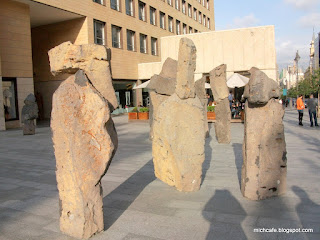
Corbero figures strolling about
They are 15 exceptional sculptures by Catalan painter, sculptor and architect Xavier Corbero that change character depending on the light and angle you look at them. Some seem to be just strolling about, others talking or embracing. But you can see them yourselves in these snapshots.

Dotted around Downtown Beirut in a sort of open museum, Corbero’s sculptures are made of basalt extracted from a particular quarry in the suburbs of Barcelona. Inspired by nature, it took him three years to complete them.

Downtown Beirut was planned and redeveloped by Solidere, founded in 1994 by the late Prime Minister Rafik Hariri, at the end of the Lebanon civil war. Solidere is the acronym in French for Lebanese Company for the Development and Reconstruction of Beirut.

 Window shopping maybe?
Information about the sculptures is sparse and about their creator mostly in Spanish, so it was interesting research.

I don’t know much about art, but I have always been drawn to public displays and grandiose patterns like those by Henry Moore and Pablo Picasso. Maybe that’s why I’m attracted to Corbero’s figures.

Corbero figures are carved in basalt
Corbero is Spain’s finest living sculptor. He was influenced in his early years by Spanish sculptor and painter Pablo Gargallo and Moore, the British sculptor and voice of British modernism.

From my first meeting with Corbero’s carved figures, I was hit by the massive bulk of the basalt, one of the most common fine-grained volcanic rock types in the world. The ocean floor is almost entirely made up of basalt, and maybe that’s what gives the stone a slippery feeling.

Perhaps it’s the way the figures are positioned, in relation to the space and to one another that is as important as their bulk and mass… Who knows in art? 

The sculptor settled in Spain’s remote Esplugues region in the late 1950s and since then has built a dream environment and refuge where artists live and work. Painters and sculptors are offered a free room and studio to explore their creativity at the Fundacion Xavier Corbero.

Salvador Dali was Corbero’s first patron although he didn’t know it -- a tale I found repeated often while looking up the artist about their relationship. Corbero says: “I didn't know he was my patron until many years later. Somebody had called on the phone and said ‘Hello, this is Dali.’ I thought it was a friend pulling my leg, so I said, ‘Yes, and I am the bishop,’ and hung up."

Xavier Corbero
Many years later, during an exhibition in New York, Dali visited the gallery every day. Corbero asked him why, and the great painter replied: "Because I find your work very interesting. The only problem is that you aren’t very polite given that I bought everything at your exhibition.”

Corbero’s roots are in Spain’s Catalan region, specifically Barcelona, a city famous for its public displays of art. Ahead of the 1992 Barcelona Summer Olympics, he organized for artists to create public art projects in the city and many of his own massive works line major boulevards. He also created the 1998 Olympic medals and convinced the Olympic committee to use real gold in them for the first time in the history of the Games.

The old and the new in Downtown Beirut
After saluting my 15 friends, I continued my tour of Downtown Beirut, admiring the blend of old and new in the Souks’ restored streets and alleys as well as in the churches and mosques, often sitting side-by-side.

And I headed towards the new and upcoming district at the Port of Beirut, off the waterfront, which is developing into a new shopping area. There too, the mix of old houses and buildings contrasts with the designer boutiques.

So far there are three that launched in December – Maison Rabih Kayrouz, which I didn’t dare enter but whose windows were decked out with beautiful green, red, yellow and blue dresses and evening gowns; the Karen Chekerdjian Store for creative houseware; and a new branch of the famous and iconic IF Boutique.

Saydet al-Nourieh Church and Al-Amin Mosque
But there is that much you can walk and it was time to retrace my steps, past the Al-Amin Mosque and the picturesque Saydet al-Nourieh Church (Our Lady of Light), and take a shared cab, or servees, back home to Hamra.
Thursday, April 21, 2011

Easter Bunnies at Beirut Souks

The Easter garden at Beirut Souks
It’s Easter in Beirut’s major commercial district. The bunnies are out and about in their singing garden, busy sowing, coloring eggs, picking flowers and preparing for the big day on Sunday.

The Beirut Souks are dear to my heart. They were a daily destination whenever I visited Beirut with the family while growing up and later when I returned to live here in 1973. My two uncles, Adeeb and Majeed, had shops there, the first in Souk Ayyas and the second in Souk al-Jameel. We would invariably pass by to see them, stopping first to get a fresh drink from the Bourkeh or Pool – a circular traditional outdoor place that at the time served every imaginable fresh juice.

Bunnies busy setting the table
The singing tree
I headed there on my first evening in Beirut on Monday (April 18) and was immediately drawn by the music at the end of the Souks complex, called Ajami Square. And that’s where I discovered the Easter garden and couldn’t resist taking pictures to share (see here).

There were lots of families taking pictures of the children and enjoying the different scenes the rabbits were performing and of the large singing tree. I thought it was an excellent idea and certainly enjoyable for the strollers and visitors.

Beirut Souks, in the major downtown commercial district, have more than 200 shops and have always been the heart of Beirut’s business area. They were also destroyed beyond repair during the 1975-1990 civil war and were rebuilt by Solidere according to the original grid plan and location while maintaining the landmarks and street names. Many people have a love-hate relationship with the renovated downtown district. But it is always an attraction.

Beirut Souks (photo via Solidere.com)
Solidere, which in French stands for “Société libanaise pour le développement et la reconstruction de Beyrouth” (or “The Lebanese Company for the Development and Reconstruction of Beirut”), was founded in 1994 by the late prime minister Rafik Hariri. Its vision is of “Beirut city center as a complete, synergetic district” enhancing the economic vitality and social vibrancy of the central district through a “signature shopping, hospitality, entertainment and cultural meeting place.” 

Apart from Souk Ayyas and Souk al-Jameel, there was Souk al-Tawileh and Souk al-Franj, Lebanon’s biggest fruit, vegetable and flower market, where I still remember shopping with my grandfather.

Designed in five separate commissions by international and Lebanese architects, Beirut Souks offer 128,000 square meters of built-up area interspersed with landscaped pedestrian zones. They are divided into two main parts.

The South Souks was designed by architects Rafael Moneo (Spain) and Samir Khairallah & Partners; the Gold Souks by Kevin Dash (UK) and Samir Khairallah & Partners; and the North Souks by Valode et Pistre (France) / Annabel Kassar and Zaha Hadid.

During the restoration, many archeological findings were made and integrated in the landscape, including the ancient Phoenician commercial quarter, the medieval moat, the Mameluk Koranic madrassa of Ibn Iraq al Dimashqi; and the restored mosaics from Byzantine shops in Souk al-Franj.

Preparing the egg hunt for Easter morning
Part of the wall painting
In the meantime, the rabbits are preparing for Easter…