Pages

Showing posts with label Solidere. Show all posts

Wednesday, June 29, 2011

Lighting Downtown Beirut in song


Lighting Beirut Architecture
While Downtown last week, I noticed posters all over announcing Lighting Beirut Architecture. My curiosity drove me to probe further.

From a page on Facebook, I discovered it was project being launched by Solidere. The plan was to light up a large urban area using permanent image projection to reveal the architecture by night.

The first phase of the project, on June 18, lit up 28 key buildings and sites in Downtown Beirut -- in Foch, Allenby, Weygand and Fakhry Bey Streets, Bab Idriss and Beirut Souks.

As I made my way Downtown with my cousin Lillian just before 8 p.m., I didn’t know what to expect. We were pleasantly surprised to find throngs of people gathering at Trablous Street, in front of the old building of Beirut’s French-language daily L’Orient-Le Jour, where the ceremony was due to kickoff.

As dusk fell, we realized it was going to be an absorbing evening. L’Orient’s building was covered in several vertical long sheets with a stage in front. People were milling about Beirut Souks in expectation, sitting in the various restaurants and coffee shops and finally converging toward the stage.

People gathering on Trablous Street
Mounir Douaidy on stage
After a brief introduction to the event by Solidere General Manager Mounir Douaidy, we waited eagerly for the evening’s centerpiece: a performance by Tripoli’s Acapella Fayha Choir. I sensed the crowd’s excitement when this was announced and felt ignorant not to have heard of the choir or known what Acapella -- signing without instruments -- is.

The captivating Fayha Choir
has become Lebanon’s leading, and internationally renowned, Acapella choir. Maestro Barkev Taslakian, the artistic director and conductor, now leads a nearly 50-member group from Tripoli and its suburbs. The choir’s program includes Lebanese, Oriental, as well as French, English, Latin, Armenian and other songs.

Enthralled by Maestro Barkev Taslakian's energy...
... and the beauty of the voices
I remembered talk about the choir when they appeared on the TV show “Arabs Got Talent” early this year. And as soon as they started singing, I was captivated. The choir’s voices, in the setting of Beirut Souks, as the sky was turning darker and the lights becoming more dominant, had all those present mesmerized and in awe of the singers’ talents.

Reine Merhebi cheered by...
...her mother and brother
It was also special because I bumped into a woman while trying to capture the event on my camera. After apologizing, we got talking. She beamed and pointed to one of the singers, Reine Merhebi, who is her daughter. Reine’s mother and siblings had come from Tripoli to watch her perform with the choir. She told me how her daughter loved singing and had joined the Fayha Choir two years ago. Her younger brother and sister are following suit and have started rehearsing with the group.
L'Orient building unveiled in the background
While the choir was singing, the first lighting of the L’Orient building was unveiled and the sheets dropped one by one to reveal more choir members in the preserved building’s windows.

Fayha sang for more than half an hour. Being so enthralled by the energy of Maestro Taslakian and the beauty of the voices, we would have loved the performance to go on for much longer.

We were then invited to walk around and see the lighting of the other buildings while flying lanterns were released and filled the sky. Pamphlets were available with a map of where the lit buildings were.

The only building I could capture with my camera
Unfortunately, my little digital camera is not smart enough to take such pictures of buildings at night – so these were all taken from the event’s Facebook page.

With our maps in hand, we walked around. Among the buildings now lit in Downtown Beirut are: Fenicia Bank, Al Dabbagha Mosque, Idriss Building (Foch Street); Hakimi, Khawam, Tamari and Sehnaoui buildings (Allenby Street); Municipality of Beirut, Amir Assaf Mosque, Al Omari Mosque, Sursock Building (Weygand Street); the Bab Idriss sculptures, Tamari and L’Orient buildings and various Beirut Souks blocks on Fakhry Bey Street and in the Souks themselves.

From Lighting Beirut Architecture Facebook page
This new lighting technology captures and reveals buildings’ architectural value. The technique retraces the existing façade features of the structures with light, resulting in a portrayal that accurately matches the frontage, with high definition design patterns. Unlike conventional lighting, as Solidere’s Mounir Douaidy explained, fixtures are placed on rooftops facing the building that is to be lit, safeguarding the front’s masonry.

Envisioned as a sustainable solution, the projectors reduce energy consumption. No light obviously goes to waste, and the city’s dark sky is preserved. Eventually, Lighting Beirut Architecture aims to turn the city center into a lively platform for creative expression and cultural experimentation with light.

The building's front looks like lace
The project is organized, planned and financed by Solidere, the Lebanese Company for the Development and Reconstruction of Beirut Central District. Light Cibles, a French-based design studio specialized in lighting design and creation of optimal solutions for historic buildings and urban contexts, proposed the lighting concept and gobo design.

Their team undertook site surveys jointly with DIAP, another French firm dedicated to image projection and multimedia. DIAP executed the building survey and introduced a new optical concept of high definition gobo projector needed for the project.

Lebanese lighting solution providers Mamari Frères (MFR) were commissioned to find the most suitable technical solution. They partnered with Italian manufacturers Lampo and conceived and developed a projector assembled by hand to bear all weather conditions.
Designers Vanessa and Yasmeen
While crossing from one street to the other in the Souks and Downtown, we passed a reception to open a new boutique, Pastel. We went in, had a look, a drink, and a cupcake and met two of the designers, Vanessa and Yasmeen, from Morocco. Yasmeen also has a boutique called Vintage Story in Kantari and Vanessa’s label is called Pinto.

There’s much more to come… That morning, I walked round an area I hadn’t been to for years and there are also titbits and more choirs and singing from the Music Festival, held on June 21 to greet the advent of summer.

You can see more pictures of the evening here.

Thursday, June 16, 2011

Carved figures come to life in Beirut


Four Xavier Corbero sculptures
Whenever I’m in Beirut, I go visit the sculptures peppering the entrance to the Souks. It’s always interesting to hear people’s comments as most think they are a waste of money and “just stones.” They either love them or hate them, a bit like Marmite.

I love these huge figures. They make you stop, think, discuss… And the idea of public works of art -- accessible, in the open for all to see and appreciate (or disparage) – is brilliant.
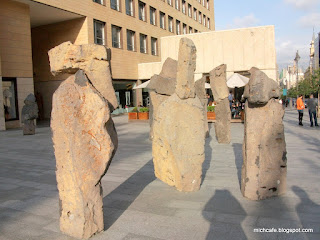
Corbero figures strolling about
They are 15 exceptional sculptures by Catalan painter, sculptor and architect Xavier Corbero that change character depending on the light and angle you look at them. Some seem to be just strolling about, others talking or embracing. But you can see them yourselves in these snapshots.

Dotted around Downtown Beirut in a sort of open museum, Corbero’s sculptures are made of basalt extracted from a particular quarry in the suburbs of Barcelona. Inspired by nature, it took him three years to complete them.

Downtown Beirut was planned and redeveloped by Solidere, founded in 1994 by the late Prime Minister Rafik Hariri, at the end of the Lebanon civil war. Solidere is the acronym in French for Lebanese Company for the Development and Reconstruction of Beirut.

 Window shopping maybe?
Information about the sculptures is sparse and about their creator mostly in Spanish, so it was interesting research.

I don’t know much about art, but I have always been drawn to public displays and grandiose patterns like those by Henry Moore and Pablo Picasso. Maybe that’s why I’m attracted to Corbero’s figures.

Corbero figures are carved in basalt
Corbero is Spain’s finest living sculptor. He was influenced in his early years by Spanish sculptor and painter Pablo Gargallo and Moore, the British sculptor and voice of British modernism.

From my first meeting with Corbero’s carved figures, I was hit by the massive bulk of the basalt, one of the most common fine-grained volcanic rock types in the world. The ocean floor is almost entirely made up of basalt, and maybe that’s what gives the stone a slippery feeling.

Perhaps it’s the way the figures are positioned, in relation to the space and to one another that is as important as their bulk and mass… Who knows in art? 

The sculptor settled in Spain’s remote Esplugues region in the late 1950s and since then has built a dream environment and refuge where artists live and work. Painters and sculptors are offered a free room and studio to explore their creativity at the Fundacion Xavier Corbero.

Salvador Dali was Corbero’s first patron although he didn’t know it -- a tale I found repeated often while looking up the artist about their relationship. Corbero says: “I didn't know he was my patron until many years later. Somebody had called on the phone and said ‘Hello, this is Dali.’ I thought it was a friend pulling my leg, so I said, ‘Yes, and I am the bishop,’ and hung up."

Xavier Corbero
Many years later, during an exhibition in New York, Dali visited the gallery every day. Corbero asked him why, and the great painter replied: "Because I find your work very interesting. The only problem is that you aren’t very polite given that I bought everything at your exhibition.”

Corbero’s roots are in Spain’s Catalan region, specifically Barcelona, a city famous for its public displays of art. Ahead of the 1992 Barcelona Summer Olympics, he organized for artists to create public art projects in the city and many of his own massive works line major boulevards. He also created the 1998 Olympic medals and convinced the Olympic committee to use real gold in them for the first time in the history of the Games.

The old and the new in Downtown Beirut
After saluting my 15 friends, I continued my tour of Downtown Beirut, admiring the blend of old and new in the Souks’ restored streets and alleys as well as in the churches and mosques, often sitting side-by-side.

And I headed towards the new and upcoming district at the Port of Beirut, off the waterfront, which is developing into a new shopping area. There too, the mix of old houses and buildings contrasts with the designer boutiques.

So far there are three that launched in December – Maison Rabih Kayrouz, which I didn’t dare enter but whose windows were decked out with beautiful green, red, yellow and blue dresses and evening gowns; the Karen Chekerdjian Store for creative houseware; and a new branch of the famous and iconic IF Boutique.

Saydet al-Nourieh Church and Al-Amin Mosque
But there is that much you can walk and it was time to retrace my steps, past the Al-Amin Mosque and the picturesque Saydet al-Nourieh Church (Our Lady of Light), and take a shared cab, or servees, back home to Hamra.
Sunday, May 29, 2011

“Meen” start to Lebanon festivals

Meen in concert at Beirut Souks
Going to Beirut for just four days, as I did for work last Monday to Thursday (May23-26) is an exhausting, albeit enjoyable, experience. There is so much to do and partake in – except that work hinders most leisure activities!

The festival season in Lebanon has kicked off in earnest and I hope I will be able to attend some of the planned entertainment.

The fans at the Beirut Music and Art Festival
One event I couldn’t miss on May 24 (though it meant being on my feet for more than 10 hours that day) was attending a concert at Beirut Souks by my friends Meen the Band. The concert was part of the first edition of the Beirut Music and Art Festival (BMAF).

BMAF launches the spring and summer festival season from May 27 to June 12 with a combination of local musicians, international performers and all forms of art.

Organized by the Ministry of Tourism in cooperation with Solidere, the private company licensed to rebuild downtown Beirut after the civil war, BMAF aims to “put culture back on the daily agenda.”

The event planners are Beirut Jazz Festival co-organizer John Kassabian, Beirut Hamra Street Festival co-organizer Fadi Ghazzaoui and businessperson Imad Darwish Hussami. They join forces and bring years of marketing, PR and managerial experience to organize what they hope becomes an annual event.

BMAF, in Downtown Beirut, is split over two venues. Three bands perform every night at the Music Village in Beirut Souks, with over 45 local acts and a few international musicians joining in from May 18 to June 3. The Grandstand at the New Waterfront District (BIEL) is host to nine nocturnal performances by international bands and artists from May 27 to June 12.
The Grandstand seats 4,000 and among those performing there is Earth Wind & Fire, Sister Sledge, Ilham al Madfai Band, Lena Chamamyan, Marcel Khalife, Rami and Bachar Khalife.

Meen the Band performed at the Beirut Souks Music Village as did Eileen Khatchadourian, the Arthur Satyan Organ Trio with special guest Larry Coryell, Adonis, Nadine has got Soul, Who Killed Bruce Lee, Zeid and the Wings, Tha-gha-ra...

My first Meen CD
I had the pleasure of meeting Meen the Band founder Toni Yammine at Beirut’s first Geekfest in February 2010. He then gave me their first CD, which I still listen to in the car. I have been a fan since.

Toni and Fouad Yammine
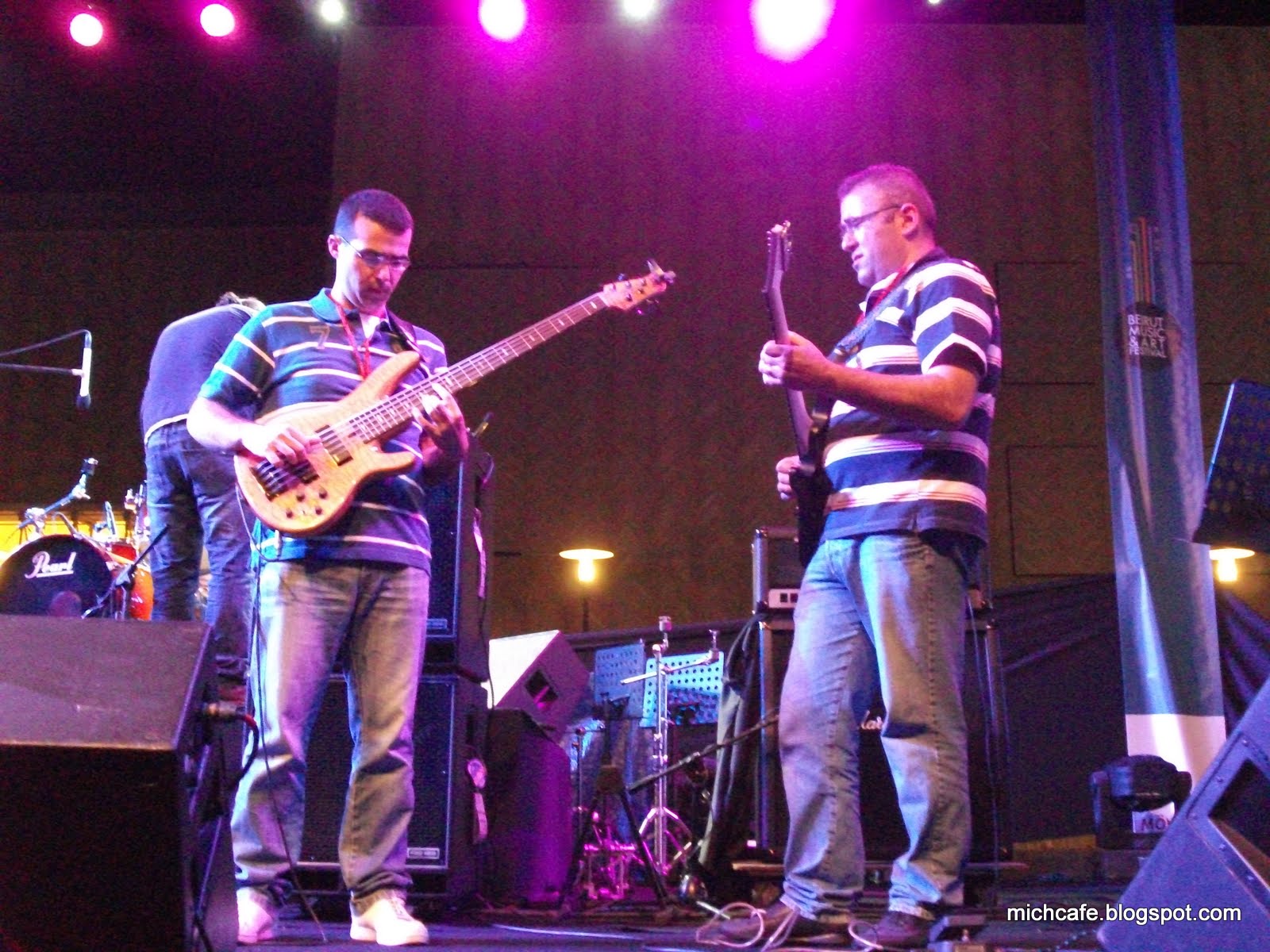
Meen is a Lebanese rock band founded by Toni and his brother Fouad Yammine, with four friends. Toni, who plays acoustic guitar, and Fouad, the vocalist, are the minds behind the Arabic catchy lyrics and tunes. Ralf Choueiri plays drums (he was absent on the night and replaced by Alain); Makram Aboul Husn, base guitar; Bernard Najm, keyboards; and Joe Hammam, electric guitar.

Makram Aboul Husn and Joe Hammam

Bernard Najm
Listening to their CD, a live recording of a May 2009 concert, was captivating. But it didn’t prepare me enough for Meen’s electrifying presence on stage, their interaction with the audience, the devotion of the fans and, above all, the incredible music, especially from guitarist Joe Hammam.

Belting Nasheed el Banadoura, fathe Tomato Anthem
They belted some of the band’s classic hits, including Pussycat, Wil Khasr Yhizz, Nasheed el Banadoura, Imm George, Jongar, which had the audience in stitches and demanding more.

Each band member is cheered by name and Fouad has a way of engaging the public, song by song, as well as his bandmates. He has such a thrilling presence on stage while his voice carries you along word by word.

Yasmine Hajjar and Maya Zankoul among the Meen fans
I didn’t think I would enjoy rock in Arabic, but Meen had me bouncing and dancing around in front of the stage, with friends Yasmine Hajjar, Maya Zankoul, Mher and Christine Krikorian, Ibrahim Nehmeh, Nadim Abou Alwan, and all the other fans.

I came away from the concert converted and more of a Meen admirer. I look forward to their next CD, which the band announced will be released imminently.

For a $10 entrance fee, the Music Village is set up with tables, chairs and sofas, where you can spend the whole evening enjoying drinks from the bar, a shawarma sandwich or some popcorn, from different stands.
Who Killed Bruce Lee on stage
We were lucky to catch Indie and electrorock band Who Killed Bruce Lee before Meen’s performance. They too were a great discovery for their passionate performance and excellent music.
The Lebanese group -- composed of Wassim Bou Malham (lead vocals and guitar), Hassib Dergham (keys and synth), Pascal Sarkis (bass guitar and backing vocals), and Malek Rizkallah (drums and backing vocals) -- is writing and producing their first album.

I’m disappointed to be missing Marcel Khalife, in a first performance with his sons Rami and Bachar on June 11 at the BAMF Grandstand. Their artistic work began in 2000 when both Rami and Bachar joined Al Mayadine Ensemble that Marcel set up in the late 1970s.

The BMAF program promises that “the oud, piano, and percussion engage in a conversation of melody, playfulness, noisemaking, or love -- elements the three artists have long explored -- traversing their entire range of dynamic extremes, from shouting to whispering, from an outpouring of passion to a diffident reserve… to the last note.”

Another event I couldn’t fit in was the Garden Show and Spring Festival. It opened for four days on May 24. It is held at the Beirut Hippodrome, which according to my cousin Lillian, who visited on May 24, is transformed into a green oasis of sweet-scented flowers and exotic plants and stalls selling garden accessories and local crafts.
Coming up next will be Beiteddine Art Festival from June 24 to August 5 in the courtyards of the Beiteddine Palace, in the Chouf Mountains.

Byblos International Festival starts June 28. The ancient port and UNESCO World Heritage Site becomes the meeting point of east and west with a lineup of Arabic and world music through July 3. (See Lebanon’s piece of history: Byblos – May 22, 2011)

Baalbeck International Festival is also on the agenda. It is the oldest and most famous cultural event in the Middle East. It has been held in Lebanon’s Bekaa Valley since 1955. The annual, much-anticipated extravaganza is a mixture of classical music, dance, theater, opera, and jazz as well as modern world music performed in July and August in the ancient Roman Acropolis, one of the largest and well-preserved Roman temples ever built.

All of this is much art forms to take in, but at least I started well with Meen’s performance. I hope to take in more acts on my next trips back to Lebanon.

Join me here for the Meen concert in pictures.