Pages

Showing posts with label Twitter. Show all posts

Friday, July 17, 2015

Is the Web dying?

Illustration by Tim McDonagh
Every now and then you read an absolute gem online that says exactly what you have been thinking but don’t have the words to express.

An article by Iranian blogger Hossein Derakhshan, published in Matter, is a case in point.

Is the web showing “a departure from a books-internet toward a television-internet?” he wonders, adding:  “We seem to have gone from a non-linear mode of communication — nodes and networks and links — toward a linear one, with centralization and hierarchies.

“The web was not envisioned as a form of television when it was invented. But, like it or not, it is rapidly resembling TV: linear, passive, programmed and inward-looking.”

His article, written after an absence of seven years in jail, gives a perspective on the web that we might have lost sight of in our daily interactions.

Yes, there was excitement about writing a blog all those technology years ago. Now it is a rush to post a photo of the food you are going to eat, the selfie, the cat… and the visual has taken over.

But Derakhshan says it much better:

“Maybe it’s that text itself is disappearing. After all, the first visitors to the web spent their time online reading web magazines. Then came blogs, then Facebook, then Twitter. Now it’s Facebook videos and Instagram and SnapChat that most people spend their time on. There’s less and less text to read on social networks, and more and more video to watch, more and more images to look at. Are we witnessing a decline of reading on the web in favor of watching and listening?” he writes.

“But the Stream, mobile applications, and moving images: They all show a departure from a books-internet toward a television-internet…”

“This is not the future of the web. This future is television,” Derakhshan notes.

“I miss when people took time to be exposed to different opinions, and bothered to read more than a paragraph or 140 characters. I miss the days when I could write something on my own blog, publish on my own domain, without taking an equal time to promote it on numerous social networks; when nobody cared about likes and reshares.

“That’s the web I remember before jail. That’s the web we have to save.”

Derakhshan’s article is a real gem and can be read in full here: The Web We Have to Save.


Wednesday, April 1, 2015

10 facts about technology use in the emerging world

The Pew Research Center surveyed thousands of people across 32 emerging and developing nations about their technology use and how the rising influence of the internet affects their daily lives. But, Jacob Poushter writes, beyond the larger findings, Pew found some notable data points about specific countries that might have been lost in the fray.

The following are the Pew Research Center’s findings:

1 Almost no one in Nigeria, Ghana, Bangladesh and Uganda owns a landline telephone. Many people worldwide are skipping the fixed telephone line that many Americans grew up with, and this fact is most apparent in many emerging and developing nations. Only 1% of the population in Nigeria, Ghana, Bangladesh and Uganda say they own a working landline telephone in their household, while 89% in Nigeria, 83% in Ghana, 76% in Bangladesh and 65% in Uganda own cell phones. This compares with 60% landline penetration in the U.S.

2 Chinese internet users love to shop. About half of online Chinese (52%) have used the internet to buy products in the past 12 months. Given the size of the online Chinese marketplace, this goes a long way in explaining the meteoric rise of commerce giants such as Alibaba and Baidu.

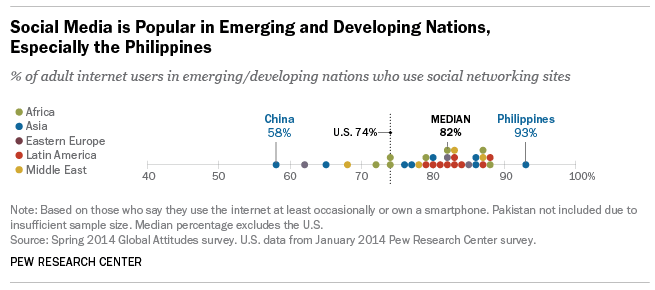
3 Filipinos love social networking. Among adult internet users in the Philippines, 93% say that they use social networking sites, such as Facebook and Twitter. This is the highest such percentage across the emerging and developing countries surveyed and greater than the 74% of internet users in the U.S. who use social networking sites. Roughly seven-in-ten of those Filipino social networkers use these platforms to share views about music and movies, while half talk about sports.


4 Indians and Bangladeshis use the internet for job hunting. Very few people in India and Bangladesh use the internet -- only 20% and 11% respectively. But among those who do, job searching is a popular activity. Majorities of internet users in Bangladesh (62%) and India (55%) say they have looked for a job online in the past year, the highest rates among the 31 countries surveyed that have enough internet users to analyze.

5 Young Thais are internet enthusiasts. In every country we polled, younger people ages 18 to 34 are substantially more likely to say they use the internet than those who are older. Especially large differences occur in Asia, and particularly in Thailand, where 83% of 18- to 34-year-olds are online, but only 27% of those 35 and older are.

6 Politics is a big social media topic in Lebanon. Among Lebanese who use social networks, an astounding three-quarters say they use the platform for discussing politics. Similar levels of political participation occur among social network users in Egypt (66%) and Jordan (63%). Across all the countries surveyed with sufficient numbers, only a median of 34% say they talk politics using social media, including 16% of Filipino and Vietnamese social networkers and 19% of Indonesians.


7 Ukrainians get their political news online. Overall, a median of 54% of internet users across emerging and developing countries surveyed use the internet to get political news and information. But in Ukraine that figure is much higher: Eight-in-ten internet users do so. The survey was fielded after the ousting of President Viktor Yanukovych from office in early 2014 and toward the beginning of the ongoing conflict with Russian-backed rebels in eastern Ukraine, meaning many Ukrainians followed those news events online. However, only 53% of Ukrainians have access to the internet.

8 Nearly eight-in-ten Russians own a computer. Due to the rise of smartphones, many people in emerging and developing nations access the internet from a device other than a personal computer. But about eight-in-ten Americans (80%) and Russians (78%) have a working computer in their household. In contrast, only 3% in Uganda say they have a computer in their home.

9 Venezuelans like taking pictures and videos with their phones. Overall, Latin Americans (just like in the U.S.) are quite keen on capturing the world around them, with more than six-in-ten mobile owners in Chile, Mexico, Argentina, Brazil and Nicaragua saying they have taken videos or pictures with their phones in the past year. In Venezuela, this is particularly common: Three-quarters of cell phone owners (who constitute 88% of the adult population) use their device to take pictures or video.

10 Many Poles access medical information online, especially women. More than six-in-ten internet users in Poland (64%) say they have gotten health information online in the past 12 months. This includes 72% of female internet users, but only 56% of male users. Similar gender gaps are found in the U.S., and also in Russia and Ukraine.

Monday, July 14, 2014

UAE’s TRA publishes Twitter White Paper

On Sunday (July 13), the Telecommunications Regulatory Authority (TRA) launched a white paper regarding Twitter usage as part of "The UAE Social Media White Papers" collection.

The series of awareness documents are designed specifically to highlight the terms and conditions of the most popular social networks in use in the United Arab Emirates (UAE). The latest release focuses on Twitter, which has around 360,000 users in the UAE who share around 2.5 million tweets per day…

The Twitter White Paper says: The laws of the UAE prohibit the publication of content which is contrary to public morals, the principles of Islam and the social and moral welfare of the UAE or any content that contains irreverence towards Islam and any other heavenly religions.

The content must also respect the UAE Government, its leadership, political institutions and ultimately the UAE’s cultural heritage and social norms and customs.

In reference to Twitter, the white paper highlights the following information as a priority for all respective subscribers:

Initially, users must not publish direct, specific threats of violence against mothers. This also includes hate speeches, and content that is threatening or contains graphic or gratuitous violence or any content that is offensive for a nation or its government. Users should think carefully about the content they are posting.

Users are responsible for the content they post and should bear this in mind if they are posting content which they do not own or which contains material that is subject to someone else’s rights.

Also, users must not publish other people’s private information without their consent.

The social networks included in “The UAE Social Media White Papers”’ collection are Facebook, Twitter, Instagram, YouTube, Yahoo/Flickr, LinkedIn, Gmail, Microsoft Outlook, Apple Store, Blackberry and Keek.


Full versions of the white papers and the corresponding infographics are accessible via the TRA’s official website: http://www.tra.gov.ae/WhitePaper/twitter.php.

Saturday, June 1, 2013

13 most beautiful things in the world

A couple of days ago, my friend Mher Krikorian (@krikOrianm) asked on Twitter: “What is the most beautiful thing in the world?”
My fingers immediately went to my keyboard to answer, then I got thinking there would be so many more than could be listed in 140 characters.
I didn’t notice any replies, at least on the timeline Mher and I share.
I have been mulling it over since and kept adding to the list. There are so many beautiful things.
It was a good exercise to get away from all the news of violence and drums of war and focus on appreciation.
My immediate thought went to places, but although well traveled, it would be presumptuous in such a large universe.
Here are a few of the “things” that for me are the most beautiful in the world:
  1. Kindness
  2. Generosity of spirit and largesse
  3. A smile
  4. The love and protection of siblings
  5. The love given and returned to the special one
  6. Books
  7. Birdsong
  8. The sun
  9. Nature
  10. The sea
  11. Pink Floyd
  12. My home
  13. Good health
I could go on and on…
What do you consider the most beautiful thing in the world?
I have disabled comments on Mich Café due to the large amount of advertising spam. But you can contribute your “most beautiful things” on Facebook or Twitter.

Tuesday, April 30, 2013

Mich Café, Best Lifestyle Blog at Beirut SMAs


Thank you, thank you, and thank you…
Mich Café has won the Beirut Social Media Award for Best Lifestyle Blog.
Thank you to all those who voted for the blog, read it, come back and believe in it.Thank you also for all the messages I have been receiving on Twitter and Facebook.
And thank you also to all the judges.
I couldn’t make it to Beirut for the ceremony last night, but followed it on Twitter and celebrated with friends in Dubai.
Celebrating in Dubai!
Liliane, Samer, Figo, Kinan, Khaled, Kamal, Abderrahman, Bahaa, George, Mher and Maisa were there to cheer me on.
Ambassador Tom Fletcher presents my award to Youssef Chaker
I was also honored to learn through his tweet that British Ambassador to Lebanon Tom Fletcher had “virtually” presented me with the award and overwhelmed me by his kind words.

Mich Cafe had also been nominated in the Blog of the Year category, which was won by my friend Najib Mitri for his BlogBaladi.
I think the biggest winner is Social Media in Lebanon, which is doing wonders for the community and the country. With better and faster Internet, it could do even more.
The Social Media Awards (SMA) allow the Lebanese online community to nominate, vote for and award bloggers, journalists, content creators, community managers, public figures, social media users and celebrities for their efforts in communication and online creation.
The SMA is the brainchild of the American University of Beirut’s Online Collaborative (AUBOC) in partnership with Beirut popular RAGMAG Magazine to honor individuals and organizations that demonstrated an exceptional presence in social media in Lebanon. (You can view the full list of nominees on RAGMAG's website.)
The SMAs can only get bigger and better.
Congratulations to the AUBOC team and to RAGMAG Magazine and I already look forward to next year’s second edition!
The Social Media Awards site said the total number of votes cast during the month was 100,947.
In the hope of winning an award, I had sent the SMA team the following video:


Watching my video at the SMAs (Photo by Yasmine Hajjar)
Congratulations to everyone who was nominated and to all the winners:

1. Best Business Blog:
Wamda
2. Best Commercial District on Social Media:
ABC
3. Best Start-up on Social Media:
Tickle My Brain
4. Best Facebook Application: Novo
5. Best Facebook Campaign/Page: Lebanese Memes
6. Most Creative Instagram Account: LiveLoveBeirut
7. Most Engaging Diplomat/Politician on Twitter: Ziad Baroud
8. Best Lifestyle Blog: Mich Café
9. Best Food & Beverage Brand: Almaza
10. Best Pub/bar on Social Media: Feb30
11. Best NGO/Organization on Twitter: Donner Sang Compter
12. Best Design for a Social Media Campaign: Almaza
13. Best Fashion Brand on Social Media: Vero Moda ME
14. Best Food Blog: No Garlic No Onions
15. Best Fashion Blog: PlushBeirut
16. Most Engaging Person on Twitter: Anis Tabet
17. Best Technology Blog: Microsoftoholic
18. Most Engaging YouTube Channel: Cheyef 7alak
19. Most Engaging Media Personality on Twitter: Neshan
20. Best News Blog: Beirut Spring
21. Most Engaging YouTube Video: Beirut Duty Free Flash Mob
22. Best NGO/Community on Social Media: Lebanese Memes
23. Best Non-Arabic Vocal Artist: Anthony Touma
24. Best Restaurant, Café or Bakery on Social Media: Roadster Diner
25. Best Band on Social Media: Mashrou3 Leila
26. Best Personal Blog: Gino’s Blog
27. Best Hotel on Social Media: Phoenicia Hotel
28. Most Engaging Celebrity on Twitter: Haifa Wehbe
29. Best Media Personality on Social Media: Zaven 
30. Best Business on Social Media: Roadster Diner
31. Best Integrated Campaign: Cheyef 7alak
32. Blog of the Year: BlogBaladi
33. Social Campaigning Magnet Award: Lana El Sahley’s L’Armoire De Lana

Related posts:

Friday, April 12, 2013

Beirut SMAs: Did you vote for Mich Café?


Did you vote yet? What? You don’t know?
Mich Café was nominated in two out of 33 categories at the Beirut Social Media Awards 2013. (See Mich Café up for 2 Social Media awards)
It is a great honor to be recognized by the virtual community and I am so proud to be a finalist in the Blog of the Year and Lifestyle Blog groups:
Blog of the Year (Category #1)
  • Blog Baladi -- www.blogbaladi.com 
  • Gino's Blog -- www.ginosblog.com 
  • Beirut Spring -- www.beirutspring.com 
  • Hummus Nation -- www.hummusnation.net 
  • Separate State of Mind -- www.stateofmind13.com 
  • Mich Café -- michcafe.blogspot.com
  • Beirut Boy -- guymeetsworld.wordpress.com
Best Lifestyle Blog (Category #4)
  • Mich Café | michcafe.blogspot.com
  • Let's tlk abt movies -- www.tlkabtmovies.com 
  • Homos Libnani -- homoslibnani.wordpress.com 
  • Nads Reviews -- www.nadsreviews.com 
  • Architecture Lab -- www.architecturelab.net 
  • If the bag Fits -- www.ifthebagfits.com 
Online voting for the finalists goes on until April 25. You can vote via Facebook or Twitter at www.smabeirut.com.
The awards ceremony takes place at the Phoenicia Hotel on April 29.
With Jen on our road trip to Sidon (11/2010)
Unfortunately, I can’t travel to Beirut for what promises to be an exciting gala. My friend Jennifer Haddad (@Jennhaddad), will represent me in case Mich Café makes it to the finals.
Jen is very much part of Mich Café. Some of my favorite posts about Lebanon were written thanks to her taking me on road trips across Lebanon – to Sidon, Tripoli, Byblos, Oyoun al-Samak and Ain Anoub.
The Social Media Awards allow the online community to nominate, vote for and award bloggers, journalists, content creators, community managers, public personalities, social media users and celebrities for their efforts in communication and online creation.
As I always say, it is mostly thanks to the vibrant, active, friendly and imaginative Lebanese online community that I started Mich Café.
While the competition is stiff in both categories, I would like to believe Mich Café has a strong chance because it is a journey of love and passion for the people, places and topics I care about.
Mich Café is I, and as it says on all my social media bios: “Just happy… the rest is not important!” That is precisely how I feel and exactly how this is reflected in Mich Café.
This blog is also about reflecting on issues outwith the local and regional box and spreading my wings further afield -- for instance: to lobby for education, protest against SOPA/PIPA, back Internet freedom in Jordan, and campaign on behalf of prisoners of conscience in Syria, against female genital mutilation, violence against women, and especially rape, because rape is rape!
Some of my favorite posts were written during my annual trips to Lebanon.
One post in particular, “Beirut: Walking in Burj Hammoud,” published in December 2010, has been viewed at least 30 times every single day since.
In Love is blind... I list, as much as I can, the reasons why I love Beirut. I could add one or two every 24 hours.

While visiting, I try to cover as many places and events as I can so as to acquaint my Lebanese, Emirati, American, British, Norwegian, German, French, Turkish, Canadian and other readers with the Lebanon I love.
These posts include:
The places, people and stories in these posts, reflect the beauty of Lebanon, its people, its culture and its food. It is the Lebanon I love and hope to go back to, while most are trying to leave it.
Mich Café is also a place I celebrate my family and friends:
Dubai, my new home is also top of the list:
The Social Media Awards 2013 is the brainchild of the American University of Beirut’s Online Collaborative (AUBOC) in partnership with Beirut popular RAGMAG Magazine.
The awards are meant to honor individuals and organizations that have demonstrated an exceptional presence in social media in Lebanon. (You can view the full list of nominees on RAGMAG's website.)
Do exercise your right to vote in the “Republic of Social Media.”
Thank you in advance to the Social Media Awards and AUBOC team as well as to RAGMAG Magazine and the judges.