Pages

Showing posts with label Middle East. Show all posts

Friday, May 1, 2015

Roger Waters to Robbie Williams: Don’t play in Tel Aviv

One UK superstar to another: If you take children and human rights seriously, please don't play Israel

Waters and Williams (Photo Credit: AP/Evan Agostini/Gero Breloer)
In a letter last week, Roger Waters explains to Robbie Williams why his decision to play in Tel Aviv tomorrow, May 2, “gives succor to [Israeli Prime Minister Binyamin] Netanyahu and his regime and endorses their deadly racist policies.”

The following is Waters’ letter published in Salon on April 28:

* * * *

Roger Waters to Robbie Williams: “Your decision to play in Tel Aviv gives succor to Netanyahu and his regime, and endorses their deadly racist policies”


Robbie Williams:

One of the most horrifying incidents during Israel’s massive assault on Gaza last summer was the killing of four Palestinian boys playing soccer on a beach.  This war crime was meticulously documented by human rights organizations and by journalists on the scene at the Al-Deira Hotel. NBC correspondent Ayman Mohyeldin tweeted that just minutes prior he had joined the children in their soccer game.  War-hardened journalists tweeted their eyewitness distress.

Gaza beach last summer (Photo by Tyler Hicks, The New York Times)
I bring up this gruesome scene because popular UK entertainer Robbie Williams, soon to play a May 2 concert in Tel Aviv, is known to be a huge soccer fan.  He is also UNICEF’s UK ambassador and a declared supporter of its Children in Danger campaign. Yet, sadly, when it comes to Palestinian children, like those killed on that beach in Gaza that day, Williams is showing a chilling indifference to their well-being.

London Palestine Action has pointed to his hypocrisy in that he purports to represent UNICEF while preparing to play a gig in Tel Aviv: “We hope UNICEF will remain steadfast in defense of children’s rights, including Palestinian children, and ask Robb

UNICEF, as declared in its mission statement, insists that “the survival, protection and development of children are universal development imperatives that are integral to human progress.”

Dear Robbie, playing this concert on May 2 would be giving your tacit support to the deaths of over 500 Palestinian children last summer in Gaza, including the four soccer players on the beach in Gaza, and condoning the arrest and abuse of hundreds of Palestinian children each year living under Israeli occupation, as has been documented by UNICEF itself.

To declare my own history, I confess I myself played a gig in Israel in 2006 before I knew any better. At that time and afterward, moved as I was, I listened to voices from all sides and made it my business to learn as much as I could about the situation in Israel and Palestine. I traveled widely in Israel and the West Bank and now nine years later having done my research, I have come to the conclusion that BDS (Boycott, Divestment, and Sanctions) is the most viable, peaceful way to end the suffering of, and forge a better future for, all the people of the Holy Land. I encourage you, Robbie, and all other artists, not to play in Israel until Israel complies with international law and recognizes the basic human rights of all the people of the region, including the Palestinian people, which, Robbie, includes Palestinian children playing soccer.

Since my 2006 gig, the Boycott, Divestment, and Sanctions movement has emerged as a dynamic force to be reckoned with. Covered heavily in mainstream media around the world, BDS has succeeded in publicizing the Palestinian people’s predicament, their lack of freedom, equality and access to justice.


Now, in 2015, there is really no excuse for musicians agreeing to play in Tel Aviv. The jury of world opinion is in; global civil society supports equal rights for all. We are approaching the same tipping point as when artists lent their support to the anti-apartheid movement in South Africa.

Those innocent soccer-playing children in Gaza were the victims of a violent indiscriminate Israeli attack.

That was more than nine months ago.  Since then, one of those kids, 12-year-old Montasser Abu Bakr, who was playing alongside his brother, and three friends, has attempted suicide and is regularly subject to uncontrollable fits of screaming and sobbing. This is one of the children whose “survival, protection and development” you, Robbie, have promised to uphold. Tragically, it is too late for Montasser’s dead brother and the other three children needlessly slain that day. But, Robbie, you can still stand up and send a powerful message as an individual and as a genuine human rights ambassador, that “business as usual” with Israel is unacceptable until such time as our Palestinian brothers and sisters are afforded equal human rights under international law and their children are not subject to this kind of obscene random slaughter.

As a UNICEF ambassador and a man of humanity and honor, you have, in my opinion, a duty to respect the picket line created by Palestinian civil society and a growing number of engaged musicians, artists and academics around the globe.  Not just Ken Loach and Stephen Hawking and Elvis Costello and Brian Eno and me, but all the other artists, thousands and counting, standing up for the oppressed and the occupied, those subjugated people that Israeli officials describe as needing to be made to “lose weight, but not to starve to death” or, worse, as grass to be mowed.

To be clear, Robbie, whether intended or not, your decision to play in Tel Aviv gives succor to Netanyahu and his regime, and endorses their exceptionalist and deadly racist policies.

So, I say, please, Robbie, look inside yourself and find the soccer fan, the man, the father who can feel another father’s loss.

If you cannot see yourself in the eyes of a Palestinian father, you should do the decent thing and resign from UNICEF, or failing that, UNICEF should let you go.

Love.
Roger Waters.

PS: To all of you reading this who care about children, thank you, we are bound together by the love we have for children, not just Montasser Abu Bakr, his brother and his friends, but the other children in Gaza and the West Bank and Israel and all the other children all over the world who should have the right to live and play in peace and safety. Our love and goodwill extends to each of them equally as we strive to encourage the creation of a Holy Land worthy of that name.

Wednesday, April 1, 2015

10 facts about technology use in the emerging world

The Pew Research Center surveyed thousands of people across 32 emerging and developing nations about their technology use and how the rising influence of the internet affects their daily lives. But, Jacob Poushter writes, beyond the larger findings, Pew found some notable data points about specific countries that might have been lost in the fray.

The following are the Pew Research Center’s findings:

1 Almost no one in Nigeria, Ghana, Bangladesh and Uganda owns a landline telephone. Many people worldwide are skipping the fixed telephone line that many Americans grew up with, and this fact is most apparent in many emerging and developing nations. Only 1% of the population in Nigeria, Ghana, Bangladesh and Uganda say they own a working landline telephone in their household, while 89% in Nigeria, 83% in Ghana, 76% in Bangladesh and 65% in Uganda own cell phones. This compares with 60% landline penetration in the U.S.

2 Chinese internet users love to shop. About half of online Chinese (52%) have used the internet to buy products in the past 12 months. Given the size of the online Chinese marketplace, this goes a long way in explaining the meteoric rise of commerce giants such as Alibaba and Baidu.

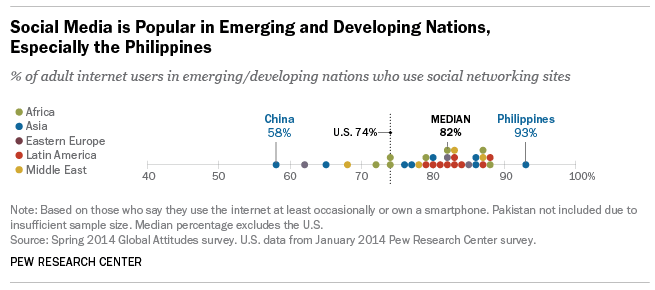
3 Filipinos love social networking. Among adult internet users in the Philippines, 93% say that they use social networking sites, such as Facebook and Twitter. This is the highest such percentage across the emerging and developing countries surveyed and greater than the 74% of internet users in the U.S. who use social networking sites. Roughly seven-in-ten of those Filipino social networkers use these platforms to share views about music and movies, while half talk about sports.


4 Indians and Bangladeshis use the internet for job hunting. Very few people in India and Bangladesh use the internet -- only 20% and 11% respectively. But among those who do, job searching is a popular activity. Majorities of internet users in Bangladesh (62%) and India (55%) say they have looked for a job online in the past year, the highest rates among the 31 countries surveyed that have enough internet users to analyze.

5 Young Thais are internet enthusiasts. In every country we polled, younger people ages 18 to 34 are substantially more likely to say they use the internet than those who are older. Especially large differences occur in Asia, and particularly in Thailand, where 83% of 18- to 34-year-olds are online, but only 27% of those 35 and older are.

6 Politics is a big social media topic in Lebanon. Among Lebanese who use social networks, an astounding three-quarters say they use the platform for discussing politics. Similar levels of political participation occur among social network users in Egypt (66%) and Jordan (63%). Across all the countries surveyed with sufficient numbers, only a median of 34% say they talk politics using social media, including 16% of Filipino and Vietnamese social networkers and 19% of Indonesians.


7 Ukrainians get their political news online. Overall, a median of 54% of internet users across emerging and developing countries surveyed use the internet to get political news and information. But in Ukraine that figure is much higher: Eight-in-ten internet users do so. The survey was fielded after the ousting of President Viktor Yanukovych from office in early 2014 and toward the beginning of the ongoing conflict with Russian-backed rebels in eastern Ukraine, meaning many Ukrainians followed those news events online. However, only 53% of Ukrainians have access to the internet.

8 Nearly eight-in-ten Russians own a computer. Due to the rise of smartphones, many people in emerging and developing nations access the internet from a device other than a personal computer. But about eight-in-ten Americans (80%) and Russians (78%) have a working computer in their household. In contrast, only 3% in Uganda say they have a computer in their home.

9 Venezuelans like taking pictures and videos with their phones. Overall, Latin Americans (just like in the U.S.) are quite keen on capturing the world around them, with more than six-in-ten mobile owners in Chile, Mexico, Argentina, Brazil and Nicaragua saying they have taken videos or pictures with their phones in the past year. In Venezuela, this is particularly common: Three-quarters of cell phone owners (who constitute 88% of the adult population) use their device to take pictures or video.

10 Many Poles access medical information online, especially women. More than six-in-ten internet users in Poland (64%) say they have gotten health information online in the past 12 months. This includes 72% of female internet users, but only 56% of male users. Similar gender gaps are found in the U.S., and also in Russia and Ukraine.

Tuesday, April 19, 2011

The Syrian comic as politician

Guest post by Middle East publisher F. Najia

It was almost 34 years ago, in August 1977. A comedian, I reasoned, should feel at home in Middle East politics. So I turned to my then heroine reporter Jumana Nuwayri at Monday Morning, the English-language weekly magazine I founded in Beirut in 1972. I asked her to talk Middle East politics with Duraid Lahham.

Duraid, better known to his fans as “Ghawwar At-Tawshi,” is a Syrian actor whose television programs, plays and movies have had millions of Arabs in stitches for several decades.

“Am I involved in politics?” he told Jumana, now Mrs. Aref Yafi. “Who in the Arab world isn’t? There was a time when anybody could say ‘I don’t talk politics.’ These days, if you don’t talk politics, you don’t talk. You’re fed politics for breakfast, lunch and dinner. It’s drilled into your ears 24 hours a day.”

He himself, he confided, is an amateur politician, interested in observing the political antics of the nation and the region. Finding out what is going on, he noted, requires a great deal of skill and talent.

“Because everything in the Middle East happens behind closed doors. The politicians meet and come out declaring, ‘It was a constructive meeting.’ I wish they would just once come out and say, ‘It was a miserable failure.’”

What, Jumana asked him, does he think happens in those secret discussions?

“Who knows? They may arrive at the momentous decision to construct a road leading to the home of one of the politicians in the meeting and come out to tell the world that they had probed ‘issues of national destiny.’”

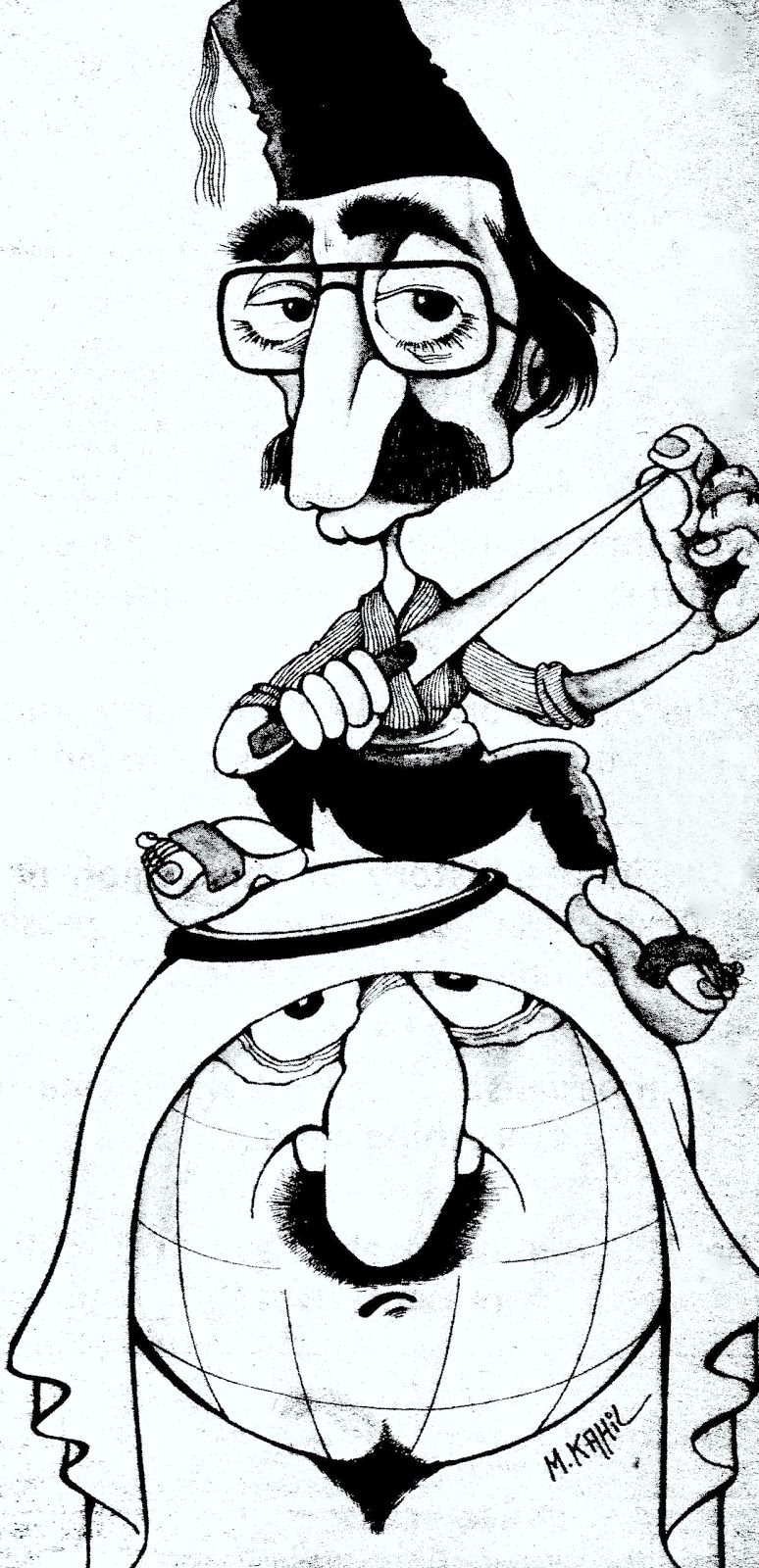
1977 cartoon of Duraid Lahham by M.Kahil
Democracy in the (1977) Arab world, Duraid said, is being slowly transformed into a series of slogans.

“Maybe that is true all over the world. Democracy has become a block of shares in the stock market. It dips when a strong chief of state takes over and revives when a weak one comes along. The strong leaders take a nation by the scruff of the neck and become the Alpha and the Omega of the state, turning democracy into a shelf ornament. When a weak leader comes along who is unable to impose his dictates, democracy flourishes.”

The Arab race is an impossible one, Duraid thought.

“I think it was Churchill who said the Arabs are unwilling to let anyone rule them, and unable to rule themselves. Look at us. If  two Arab states disagree on something, both of them become ‘traitors’ in each other’s eyes and statements. The smallest disagreement, and we are at each other’s throats.

“In England, you have two major parties – Labor and the Conservatives. When Labor is in power, the Conservatives are not slammed in jail. They work through a staid opposition. This sort of thing is unthinkable in the Arab countries. When an Arab party takes over, it sends all the other parties to jail, freezing three quarters of the country’s potential.”

The Arab world, he told Jumana, “is passing through a dangerous stage.”

He said: “Do you ever remember a time when the Arab world was not ‘passing through a dangerous phase’? I don’t. The Arab infant opens his eyes to an Arab world whose leaders warn the population that the region is going through a ‘delicate stage.’ The phase stays delicate as the infant goes to school, marries, and gets children who open their eyes to a continuing ‘dangerous phase.’ From the dawn of Arab history to the days of Arab oil, delicate stages have hounded us.”

This endless chain of “dangerous phases” is due, in part, to the collective Arab temper, which makes the Arab people go for their guns at the slightest provocation, Duraid said.

“And have you noticed how skillfully we use those guns against each other? I’ll never know why our arms skills suddenly disappear when our weapons are aimed at our enemies.”

The “dangerous phases,” he added, are also due to the fact that “everything we have we get from somebody else.”

“Strip an Arab man down to his skin, and you will find everything he wears was made abroad. The food he eats is imported. His car is made abroad. Nothing he uses is made by him, which makes him totally dependent and his country totally vulnerable. It is written (I don’t know who wrote it), ‘Woe to the nation that eats what it does not harvest and wears what it does not make.’ If that’s true, we’re in hot water.”

We are also in hot water because if we don’t have enemies to fight with, we fight with each other. “I find myself in the awkward position of asking the Almighty for problems,” he wailed. “Give us something to worry about, O Lord, so that we may not claw at each other’s faces.”

It is also noteworthy, Duraid said, that the Arabs rarely do anything wrong. If something goes wrong, it’s the fault of “the imperialists.”

“Poor imperialists. They’re blamed for everything that happens. If the electricity goes off, the imperialists did it. If the water supply is cut, the imperialists did it. If the imperialists did anything to us, it was only because our attitudes begged them to do it…

“Maybe our leaders look beyond our borders to discourage us from looking within them. Build up the other guy’s headaches, and maybe your headache will seem less painful. The fact that we’re a pretty gullible people makes the plan work. The Arabs are quick to applaud and quick to curse.”

Jumana asked him to describe the (1977) Arab nation.

He said: “You’re asking the impossible. Ask me to describe anything recognizable, and I will describe it. A statue with a head and hands and arms and legs, yes. But here you’re asking me to describe a statue that has a frying pan for a head, buckets for hands and tyres for feet. It defies description. It has no recognizable form to which you or I can relate. It never has had form.

“Take a good look at us. We’ve always had the rulers and the ruled – never the citizens and the responsible authorities… And Arab officials are lovable creatures. Even the junior official is so adored he has a couple of guards at his door. It’s a touching sight, although I haven’t decided yet whether the guards are there to protect him from the people or the people from him…

“In some countries, a man goes into politics to sacrifice his health and wealth for his people. In most Arab countries, a man goes into politics when he can’t make it in any other field. You don’t need a degree to become a politician, you see. All you need is an active tongue…

“In the Arab world, the politician gains. In other countries, he loses. In those countries, politics costs the politician a lot in terms of health and income. In our countries, a man goes into politics in a small car and ends up in a luxurious limousine; he starts out with one apartment, and ends up with 10 villas.”

How did he describe 1977 Lebanon?

“It would be unfair to describe it now (during the civil war). All I can say is that I love this country. It has always been a safety valve for me. In the old days, when I thought I was about to burst, I came (from Syria) to Lebanon, cussed my fill and went back home relieved. Lebanon is every Arab’s sweetheart, and for each Arab, it has a different attraction… Me, I like it for all its attractions.”

His answers were swift and confident.

Duraid Lahham obviously felt at home in Middle East politics. He is, after all, a comedian.