thou that art highly favored, the
Lord is with thee:
blessed art thou among women. [Luke 1:28]
Today isEid
al 3adra, the Feast of the Assumption of the
Virgin Mary to Heaven.
The
acceptance of the Mother of all Mothers into the glory of Heaven is seen as the
symbol of the promise made by Jesus Christ to all enduring Christians that they
too will be received into paradise.
John
14:3 -- one of the scriptural bases for understanding the dogma of the
Assumption of Mary -- quotes Jesus as telling his disciples at the Last Supper,
"If I go and prepare a place for you, I will come again, and will receive
you to myself; that where I am, you may be there also."
According
to Catholic theology, Mary is the pledge of the fulfillment of Christ's promise.
The Hail Maryis one of
the most powerful prayers
because it is believed Jesus cannot neglect the intercession of His mother’s
demands. The first miracle Jesus performed at the wedding at Cana is often
cited, as in John 2:1-11, when Mary told Jesus, “They have no more
wine.” He turned water into wine.
Eid al
3adra
today falls again, as it did last year, during the Holy Month of Ramadan. Both
Christians and Muslims will celebrate Our Lady – or “Maryam” in the Holy
Qur’an.
The mother
of Jesus has a distinguished and honored position among women in the Qur’an.
The 19th of
the Holy Book’s 114 chapters is titled “Maryam” – the only surah named
after a woman. (See Glorifying Virgin Mary in Ramadan --
August 15, 2011)
May our Heavenly Lady, bring peace,
solace and love to all.
And may the Mother of all Mothers shower
us, especially the needy, sick and infirm, with her Blessings:
It’s always exciting to get a telephone call (yes, some people still use one to communicate!) from my friend Jennifer Haddad. And the one I got last week didn’t disappoint.
Jen, just back from a month-long holiday in Australia, rang to say she was taking me on another road trip on Sunday (May 8). We had gone south to Sidon last November. This time we were going to discover North Lebanon and have breakfast in Tripoli. That was great news. I would be able to tell my friend in Dubai, Nada Dabliz, I visited her hometown.
Breakfast in Tripoli means only one centerpiece: Hallab.
We set out at 8 a.m. to be joined by two good friends – Bahaa Fakhriddeen, and George Zamroud -- and three new ones: Antonio Tahhan, Salvador Rudy and Charbel Saad, who I had only met on Twitter.
First we had to group and split into two cars, so we arranged to meet in the coastal city of Jounieh, 16 km north of Beirut, to begin the journey.
A glimpse of Our Lady of Lebanon at Harissa (top left)
Jounieh is known for its seaside resorts, pubs, restaurants and nightclubs, as well as its old stone souk and cable car which carries passengers up the mountain to the shrine of Our Lady of Lebanon in Harissa. While waiting for Bahaa to arrive in the second car with George and Antonio, we were parked just below Harissa.
Harissa is a pilgrimage site at an altitude of 650 meters. It is accessible either by a steep winding road or a nine-minute ascent by the téléferique. Our Lady of Lebanon, or Notre Dame du Liban, is an immense 15-ton bronze (painted white) statue of the Virgin Mary with her arms outstretched. The statue was made at the end of the 19th century and inaugurated in 1908. Inside the statue's base there is a small chapel. A huge modernistic Maronite cathedral built of concrete and glass stands right beside it.
There were more pleasant surprises. Bahaa had decided that after breakfast at Hallab, we were going to try to find a beauty spot, further north of Tripoli, called Oyoun al-Samak (fish water springs). He had seen footage of the place in the Nancy Ajram video, Ehsas Jdeed (A New Feeling) and was keen to take us all there.
The shimmering blue Mediterranean chaperones us all the way
The drive north, on the three-lane highway is pleasant on a Sunday morning as there is little traffic. It runs parallel to the coast and the shimmering blue Mediterranean chaperones you all the way.
Passing Kala'at Chekka
There’s always something interesting to see too, whether landmarks, street vendors, greenhouses... First we passed under the Casino du Liban and at one point Kala’at Chekka or Mussaylha Fort established in 1624 by Fakhriddeen II to control the North-South access, along the Nahr el-Jawz river. It is made from sandstone blocks carried from the coast and build on the limestone rock. It has three floors in good condition, as is the small Roman Bridge that leads to the fort. I was just able to get a picture.
We were getting hungry and luckily could spot Tripoli further along the coast. As we entered the port city, we asked for directions and headed straight to Hallab.
Abdul Rahman Hallab & Sons is synonymous with Tripoli. They have been pioneers in Arabic sweets since 1881.
The Hallab success story has passed on from generation to generation. Abdel Rahman’s descendants founded the famous Kasr el-Helou (the sweets’ palace) in the house where their grandfather was born and lived. Today, the famous Hallab house is run by the fourth generation, and the kasr is one of Tripoli’s most renowned touristic sites.
Arriving in Tripoli
Tripoli, Lebanon’s second largest city and its second principal port, is about 88 km north of Beirut. In old times, it was the center of a Phoenician confederation including Tyre, Sidon and Arados, thus the name meaning "triple city" in Greek.
Apart from pastries, Tripoli is known for its impressive ruins, theEs-Saboun (soap) Market, Khan al-Khayyateen (the tailors’ quarters), and a maze of narrow streets and bazaars.
Just offshore is a string of four small islands, the only ones off Lebanon. The largest, known as Palm Trees Island or Rabbits’ Island (Jazeerat al-Araneb), is a nature reserve for green turtles, rare birds and rabbits -- hence the name. It holds Roman and Crusader ruins and UNESCO declared it a protected area in 1992.
We finally reach Abdul Rahman Hallab & Sons
Charbel, Rudy, Jennifer, Bahaa and Antonio
You can tell you are approaching Abdul Rahman Hallab & Sons from the whiffs of pastry you can smell from several blocks away. Our tummies were growling when finally, around 10.30 a.m., Jennifer, George, Bahaa, Antonio, Rudy, Charbel and I filed into a packed Hallab.
Hallab's sweet delights
Rudy, Antonio, Charbel, Bahaa, Jennifer and George -- ready for breakfast
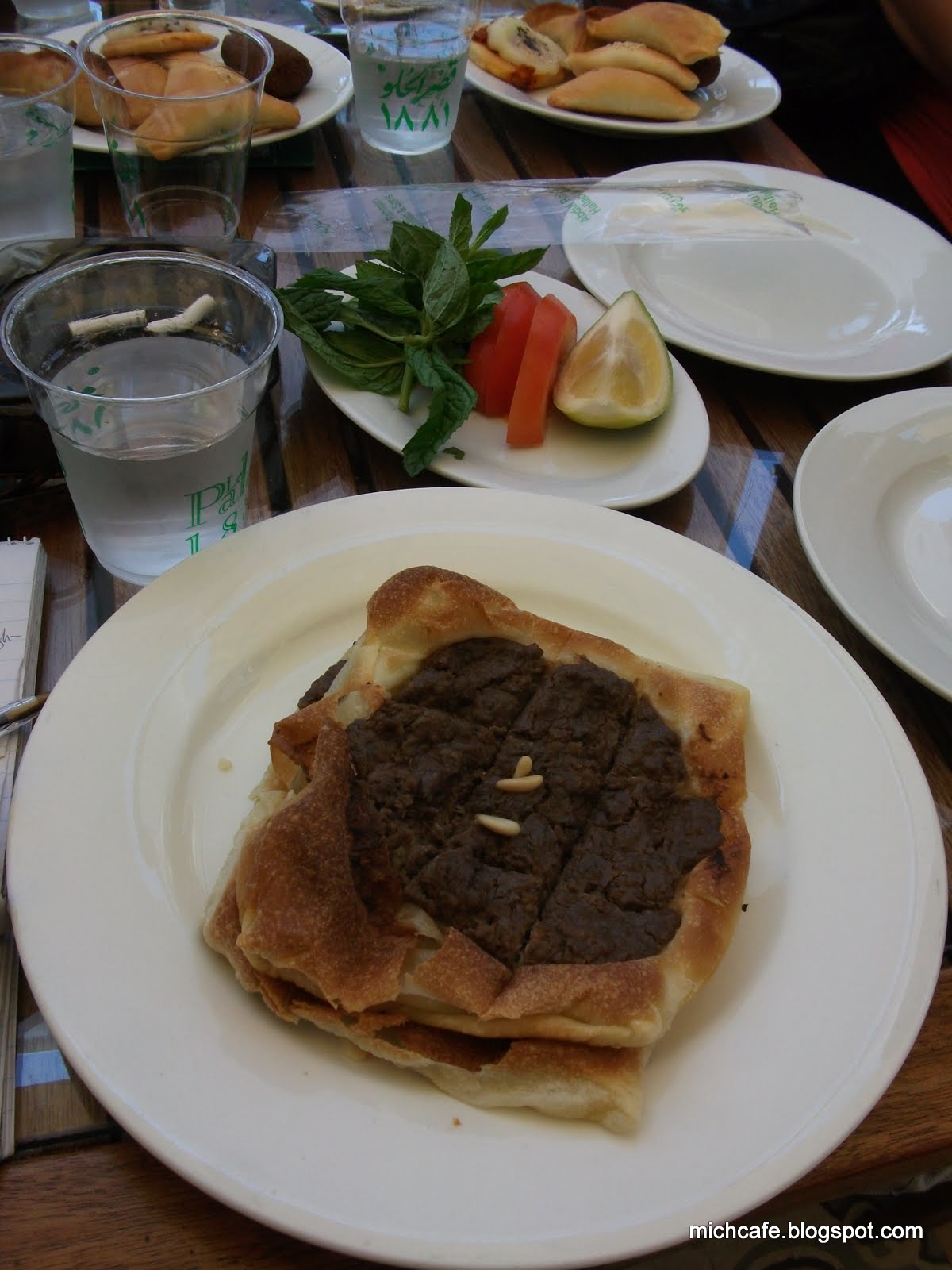
After taking a good look at the trays of sweet delights on offer, we decided to start with lahm be ajeen, the signature savory pastry with minced meat and pine nuts (LL 3500, $ 2.33, AED 8.55). We also ordered two plates of mixed savory pastries (LL 4,500, $3, AED 11 each). And I couldn’t resist the cheese knafeh either (LL 6,000, $4, AED 14.68). With juice and water, the bill for the seven of us came to LL 49,000 ($32.6, AED 120).
Hallab's lahm bi ajeen and...
... knafeh for breakfast
Antonio Tahhan, who as his blog says is “all about food,” was enjoying the experience as much as I was. A Cornell University undergraduate, he is a Fulbright and has been on a grant in Aleppo for the past seven months. He was completing an anthropological study of Syrian cuisine in the home, street and restaurant. Unfortunately, because of the current unrest in Syria, his grant was stopped and he was advised to leave the country.
Well satiated, we set off to look for Oyoun al-Samak, further north. We’ll visit the natural springs and lakes beauty spot as soon as I manage to put pen to paper. And there were more surprises on the way back to Beirut. Meantime you can ride with us to Tripoli and have breakfast with us in pictures.
Thank you Jennifer, Bahaa, George, Antonio, Rudy and Charbel for a breathtaking day.