Looking for Oyoun el-Samak in the mountain peaks and deep valleys
…So, well satisfied after breakfast at Abdul-Rahman Hallab & Sons in Tripoli (Lebanon: The day we drove north – 14 May 2011), Jennifer Haddad, Bahaa Fakhriddeen, George Zamroud, Antonio Tahhan, Salvador Rudy, Charbel Saad and I set off for the second leg of our drive to, and discovery of, North Lebanon.
Next on our itinerary (on May 8) was trying to find Oyoun el-Samak (water springs fish), a beauty spot some 30 km north of Tripoli. It was Bahaa’s idea. He had seen footage of the place in the Nancy Ajram video, Ehsas Jdeed (A New Feeling) and was keen to take us all there. The map said it would take about an hour. But that’s at bird’s flight and if you knew where you were going!
It is remarkable how many wonders this 10,452-sq.km. country, bordered by sea and mountains, holds. Among them: the Cedars, Byblos, Jeita Grotto, Qadisha Valley, A’anjar, the Pigeon Rocks and Oyoun el-Samak.
The mothballed Tripoli oil refinery
As soon as you leave Tripoli, there is a checkpoint just before the mothballed oil refinery. And we drove northward for half an hour, passing by Minniyeh, before taking a right turn to start the ascent into the Denniyeh district. It is like being hauled into another era of unspoiled natural beauty and greenery.
More than 100 kilometers north of Beirut, the roads are narrow, winding and bounded on both sides by olive groves, mountain peaks and deep valleys. The air is cleaner and cooler and fog envelops the sky.
Lost in the mountains: The air is cleaner and cooler and fog envelops the sky
Our two cars, the first driven by Jennifer, with me, Rudy and Charbel, with Bahaa driving in front with George and Antonio, drew much attention. We stopped often to ask for direction and kept heading into the mountains.
Oyoun el-Samak lies between the districts of Denniyeh and Akkar, near the village of Saffaret al-Katih. Denniyeh, east of Tripoli, extends as far as Akkar to the north; Bsharreh and Zghorta to the south; and eastwards to Baalbek and Hermel. It is a part of the country that has a rich water table, including Nahr al-Bared and its tributaries, of which is Oyoun el-Samak.
After driving on the small, winding roads for more than two hours, we finally stopped next to a house that overlooked the whole valley, to stretch our legs, take pictures and ask for further direction. We were lost.
We were then told we had to turn around and take another route. About half an hour later, we started (with difficulty) crossing some minibuses full of people and felt that we were getting closer to our destination, which at one point we thought we would never find.
Suddenly, just around another bend in the road...
... a towering mountain with gushes of water springing from within the trees
Springs wherever you look
After further snaky and tight roads along the hillside, you get to this valley transformed since the 1940s into a lake of outstanding beauty. Suddenly, just around another bend, you see a towering mountain with gushes of water springing from within the trees and bushes. The scene simply takes your breath away.
As soon as we were in full view of the magical lake and waterfalls of Oyoun el-Samak, we saw cars and buses and many motorcycles and Vespas parked with people milling around everywhere. Cars have to cross an iron bridge to park.
Cars have to cross an iron bridge to park
The view of the lakes, beyond the electric power station
Oyoun el-Samak has a 500x75-meter dam that feeds an electric power station and provides water to irrigate the region. It’s not far from Kornet al-Saouda (the black corner), the highest point in the Middle East at 3,088 meters.
Just underneath the springs -- with water flowing on all sides and through the greenery and wild flowers -- is a restaurant. They have large speakers with music covering the whole region with people eating, dancing and enjoying their Sunday break.
The restaurant at Oyoun el-Samak
Jennifer crosses the roped bridge...
... and tries not to get wet from the spray
The restaurant is built at the foot of a mountain with the spring passing underneath. There is a roped bridge that passes just in front and the spray of the water was pushing the patrons further and further back. George, and then Jennifer, tried to cross the bridge while we took photos.
The beauty of Oyoun el-Samak
George wets his feet in one of the Oyoun el-Samak springs
We also climbed the mountains towards one of the spring mouths to get a better view. I wish you could hear the sound of the water springs, flowing towards us with the birds singing in the background. There were little wild flowers all over and frogs jumping around.
Families enjoying the day out
Basking in picnics with traditional coal BBQs
We then walked around the lakes. All-around families and friends were basking in picnics with traditional coal BBQs to roast chicken and kebabs. All the people we passed invited us to join and share in their meal. We thanked them and said sahtain (bon appétit), but they would still insist on passing us a piece of fruit, a loquat or something.
Beautiful wild flowers all over
A poppy adds some color
Tables and chairs are provided, by the restaurant most probably, and are dotted here and there. Some tables had more than 30 people. Others had spread straw carpets and children were playing everywhere.
Lunch for these picnickers is nearly ready
We could have spent a lot more time at Oyoun el-Samak and take in more of its beauty, but it was nearly 5 p.m. and we were getting tired and eager to leave before dusk and the rush on the narrow roads.
Luckily, we took correct directions, and were back on the highway heading south to Beirut in about half an hour.
But the day wasn’t over yet! There is one more surprise that Jennifer, George, Bahaa, Antonio, Rudy and Charbel had in-store for me – lunch and dinner at another of Lebanon’s wonder spots. But that’s for the next post!
Meantime you can ride with us to Oyoun el-Samak and visit the natural springs and lakes beauty spot in pictures.
It’s always exciting to get a telephone call (yes, some people still use one to communicate!) from my friend Jennifer Haddad. And the one I got last week didn’t disappoint.
Jen, just back from a month-long holiday in Australia, rang to say she was taking me on another road trip on Sunday (May 8). We had gone south to Sidon last November. This time we were going to discover North Lebanon and have breakfast in Tripoli. That was great news. I would be able to tell my friend in Dubai, Nada Dabliz, I visited her hometown.
Breakfast in Tripoli means only one centerpiece: Hallab.
We set out at 8 a.m. to be joined by two good friends – Bahaa Fakhriddeen, and George Zamroud -- and three new ones: Antonio Tahhan, Salvador Rudy and Charbel Saad, who I had only met on Twitter.
First we had to group and split into two cars, so we arranged to meet in the coastal city of Jounieh, 16 km north of Beirut, to begin the journey.
A glimpse of Our Lady of Lebanon at Harissa (top left)
Jounieh is known for its seaside resorts, pubs, restaurants and nightclubs, as well as its old stone souk and cable car which carries passengers up the mountain to the shrine of Our Lady of Lebanon in Harissa. While waiting for Bahaa to arrive in the second car with George and Antonio, we were parked just below Harissa.
Harissa is a pilgrimage site at an altitude of 650 meters. It is accessible either by a steep winding road or a nine-minute ascent by the téléferique. Our Lady of Lebanon, or Notre Dame du Liban, is an immense 15-ton bronze (painted white) statue of the Virgin Mary with her arms outstretched. The statue was made at the end of the 19th century and inaugurated in 1908. Inside the statue's base there is a small chapel. A huge modernistic Maronite cathedral built of concrete and glass stands right beside it.
There were more pleasant surprises. Bahaa had decided that after breakfast at Hallab, we were going to try to find a beauty spot, further north of Tripoli, called Oyoun al-Samak (fish water springs). He had seen footage of the place in the Nancy Ajram video, Ehsas Jdeed (A New Feeling) and was keen to take us all there.
The shimmering blue Mediterranean chaperones us all the way
The drive north, on the three-lane highway is pleasant on a Sunday morning as there is little traffic. It runs parallel to the coast and the shimmering blue Mediterranean chaperones you all the way.
Passing Kala'at Chekka
There’s always something interesting to see too, whether landmarks, street vendors, greenhouses... First we passed under the Casino du Liban and at one point Kala’at Chekka or Mussaylha Fort established in 1624 by Fakhriddeen II to control the North-South access, along the Nahr el-Jawz river. It is made from sandstone blocks carried from the coast and build on the limestone rock. It has three floors in good condition, as is the small Roman Bridge that leads to the fort. I was just able to get a picture.
We were getting hungry and luckily could spot Tripoli further along the coast. As we entered the port city, we asked for directions and headed straight to Hallab.
Abdul Rahman Hallab & Sons is synonymous with Tripoli. They have been pioneers in Arabic sweets since 1881.
The Hallab success story has passed on from generation to generation. Abdel Rahman’s descendants founded the famous Kasr el-Helou (the sweets’ palace) in the house where their grandfather was born and lived. Today, the famous Hallab house is run by the fourth generation, and the kasr is one of Tripoli’s most renowned touristic sites.
Arriving in Tripoli
Tripoli, Lebanon’s second largest city and its second principal port, is about 88 km north of Beirut. In old times, it was the center of a Phoenician confederation including Tyre, Sidon and Arados, thus the name meaning "triple city" in Greek.
Apart from pastries, Tripoli is known for its impressive ruins, theEs-Saboun (soap) Market, Khan al-Khayyateen (the tailors’ quarters), and a maze of narrow streets and bazaars.
Just offshore is a string of four small islands, the only ones off Lebanon. The largest, known as Palm Trees Island or Rabbits’ Island (Jazeerat al-Araneb), is a nature reserve for green turtles, rare birds and rabbits -- hence the name. It holds Roman and Crusader ruins and UNESCO declared it a protected area in 1992.
We finally reach Abdul Rahman Hallab & Sons
Charbel, Rudy, Jennifer, Bahaa and Antonio
You can tell you are approaching Abdul Rahman Hallab & Sons from the whiffs of pastry you can smell from several blocks away. Our tummies were growling when finally, around 10.30 a.m., Jennifer, George, Bahaa, Antonio, Rudy, Charbel and I filed into a packed Hallab.
Hallab's sweet delights
Rudy, Antonio, Charbel, Bahaa, Jennifer and George -- ready for breakfast
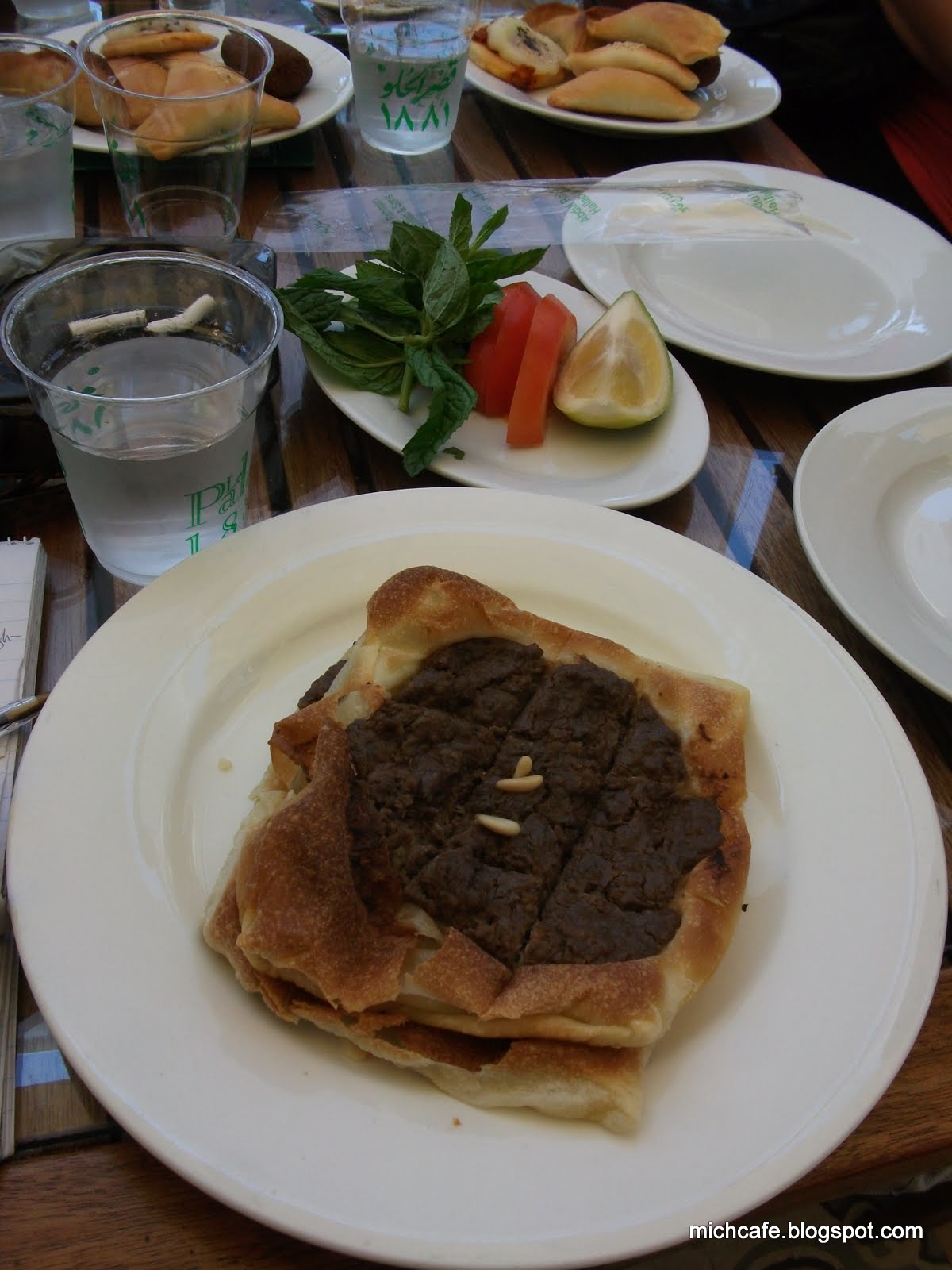
After taking a good look at the trays of sweet delights on offer, we decided to start with lahm be ajeen, the signature savory pastry with minced meat and pine nuts (LL 3500, $ 2.33, AED 8.55). We also ordered two plates of mixed savory pastries (LL 4,500, $3, AED 11 each). And I couldn’t resist the cheese knafeh either (LL 6,000, $4, AED 14.68). With juice and water, the bill for the seven of us came to LL 49,000 ($32.6, AED 120).
Hallab's lahm bi ajeen and...
... knafeh for breakfast
Antonio Tahhan, who as his blog says is “all about food,” was enjoying the experience as much as I was. A Cornell University undergraduate, he is a Fulbright and has been on a grant in Aleppo for the past seven months. He was completing an anthropological study of Syrian cuisine in the home, street and restaurant. Unfortunately, because of the current unrest in Syria, his grant was stopped and he was advised to leave the country.
Well satiated, we set off to look for Oyoun al-Samak, further north. We’ll visit the natural springs and lakes beauty spot as soon as I manage to put pen to paper. And there were more surprises on the way back to Beirut. Meantime you can ride with us to Tripoli and have breakfast with us in pictures.
Thank you Jennifer, Bahaa, George, Antonio, Rudy and Charbel for a breathtaking day.